Cúchulainn: The Hound of Ulster
Epic journeys, legendary deeds, and the greatest heroes of myth.
- 1The 12 Labors of Hercules: Strength, Trials, and Redemption
- 2Gilgamesh: The First Epic Hero
- 3Cúchulainn: The Hound of Ulster (you are here)
- 4Theseus and the Minotaur: Bravery and Intelligence – Hero of Athens
- 5Aeneas and the Journey to Italy
- 6Karna: Hero of Tragedy – Loyalty, Valor, and Fate in the Mahabharata
- 7The Monkey King – Sun Wukong’s Rebellion Against Heaven
- 8Māui: The Trickster Demigod
Across the legends of Ireland, countless warriors fought for honor, kings battled for power, and heroes sought immortal fame. Yet among them all, one name echoes louder than any other: Cúchulainn, the Hound of Ulster.
His story is one of breathtaking courage and heartbreaking tragedy. He was a warrior whose strength bordered on the supernatural, a champion who stood alone against entire armies, and a hero whose destiny was written long before he understood its cost. Like Achilles of Greek mythology, Arjuna of the Mahabharata, or Sigurd of Norse legend, Cúchulainn achieved greatness that would outlive him. Yet that greatness came at a terrible price.
The ancient Irish remembered him not simply because he won battles, but because he embodied the very spirit of heroism itself—fearless in the face of impossible odds, loyal to his people, and willing to sacrifice everything for honor.
His tale remains one of the most powerful stories in Celtic mythology, blending glory and sorrow into a legend that has endured for centuries.
The Boy Called Setanta
Long before he became the legendary Hound of Ulster, the hero was known as Setanta.
Even as a child, stories of his extraordinary abilities spread throughout Ireland. While other children played games, Setanta displayed strength, speed, and courage far beyond his years. He could outrun older boys, defeat skilled opponents in contests, and wield weapons with astonishing precision.
Those around him quickly realized that there was something different about the young boy.
According to tradition, Setanta was the son of Sualtam, a mortal nobleman, and the divine hero-god Lugh of the Long Arm. Through his father flowed the blood of the Tuatha Dé Danann, the supernatural race that once ruled Ireland before the arrival of humans.
This divine heritage gifted Setanta with extraordinary abilities, but it also tied him to a destiny from which there would be no escape.
The moment that earned him his famous name occurred when he was still very young. Arriving late to a feast hosted by the smith Culann, Setanta found himself confronted by a gigantic guard dog renowned for its ferocity. The beast attacked immediately.
Acting instinctively, Setanta defended himself and killed the hound.
The victory brought him no joy. Realizing that he had deprived Culann of his prized protector, the boy offered to take the dog's place until a replacement could be trained.
The gesture impressed everyone present.
From that day forward, he became known as Cúchulainn—"The Hound of Culann."
It was a name that would become legendary throughout Ireland.
Training for Greatness
As Cúchulainn grew older, his hunger for mastery became impossible to ignore.
Determined to become the greatest warrior in Ireland, he traveled to Scotland to train under the legendary warrior woman Scáthach. Her fortress stood in a distant and dangerous land where only the bravest students dared seek instruction.
Training under Scáthach was brutal.
Students were pushed beyond their physical limits and taught techniques unknown to ordinary warriors. It was here that Cúchulainn learned the arts of combat that would make him nearly unbeatable.
Most importantly, he mastered the use of the Gáe Bolga, a terrifying spear capable of inflicting devastating wounds. Once unleashed, the weapon was nearly impossible to defend against.
Under Scáthach's guidance, the young warrior transformed from a gifted fighter into a living weapon.
Yet even as his skills increased, so did the shadow of fate following him.
Many prophecies foretold that Cúchulainn would achieve everlasting fame but die young. He accepted this destiny without hesitation.
For him, a short life filled with glory was preferable to a long life forgotten by history.
The Warp-Spasm: Fury Made Flesh
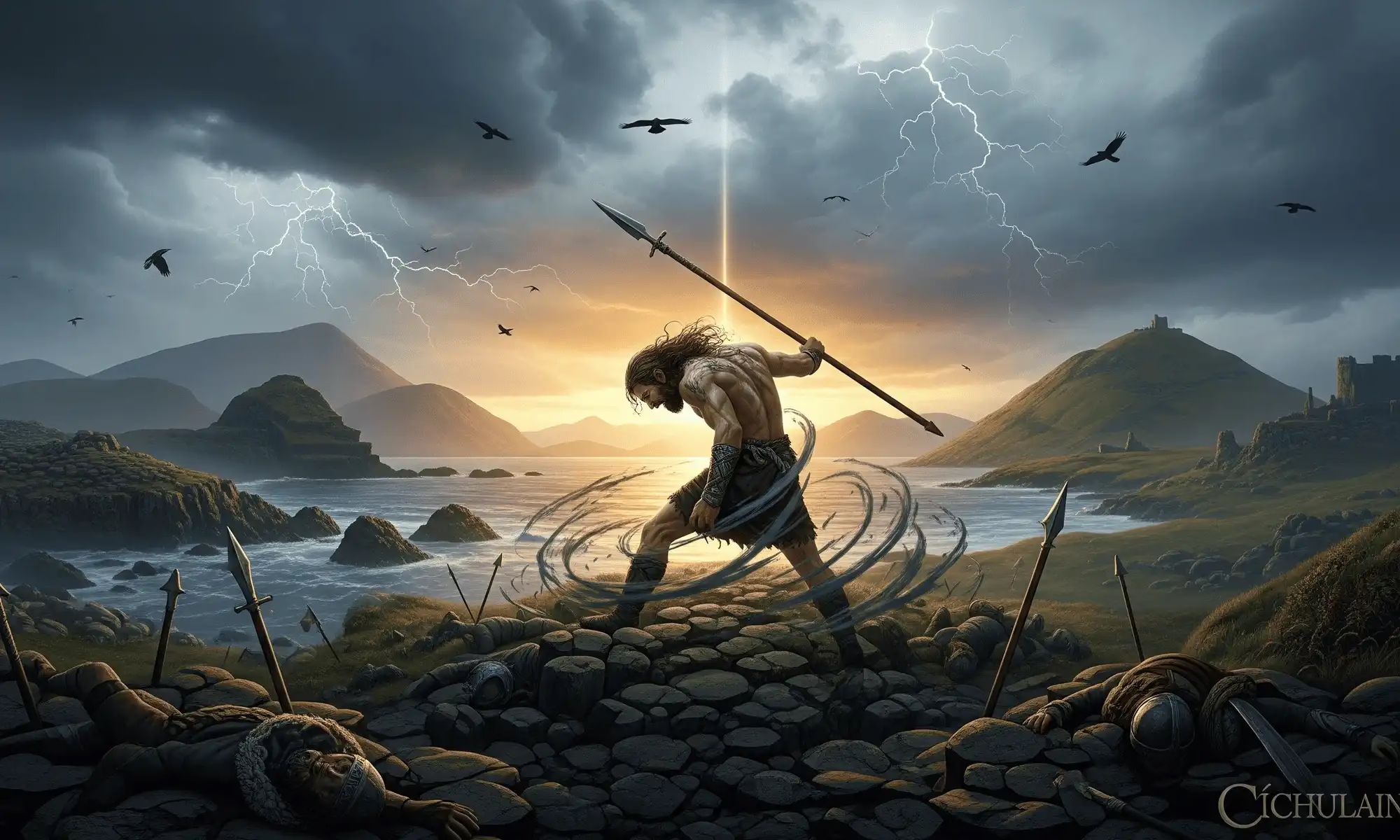
What truly separated Cúchulainn from every other warrior was his terrifying battle transformation known as the Ríastrad, or Warp-Spasm.
When his battle fury overtook him, he became something more than human.
Ancient descriptions portray a transformation so disturbing that even his allies struggled to recognize him. One eye would sink deep into his skull while the other bulged outward. His muscles twisted unnaturally. His hair stood upright like sharp spikes, and heat radiated from his body like a furnace.
The calm and noble warrior disappeared.
In his place stood a force of destruction that seemed closer to a god—or a monster—than a man.
Enemies who witnessed the Warp-Spasm often fled before battle even began.
For the ancient Irish, this transformation symbolized the terrifying reality of warfare itself. Battle could elevate a hero to greatness, but it could also consume his humanity.
Cúchulainn embodied both truths.
The Cattle Raid of Cooley
The defining chapter of Cúchulainn's life came during the great conflict known as the Táin Bó Cúailnge, or the Cattle Raid of Cooley.
The war began when Queen Medb of Connacht sought to capture the legendary Brown Bull of Cooley, one of the greatest treasures in Ireland. To seize it, she assembled a massive army and marched against Ulster.
Normally, the warriors of Ulster would have risen to defend their homeland.
But a supernatural curse struck them at the worst possible moment. One by one, the warriors were overcome by magical weakness, leaving the province defenseless.
All except one.
Cúchulainn alone remained untouched by the curse.
Barely more than a youth, he found himself standing between his homeland and an invading army.
What followed became one of the greatest heroic feats in world mythology.
The Lone Defender of Ulster
Rather than facing the army directly, Cúchulainn relied on courage, skill, and ancient customs.
According to tradition, warriors could challenge enemy champions to single combat. By invoking this custom repeatedly, Cúchulainn delayed the advance of Medb's forces.
Day after day, champion after champion came forward.
Day after day, they fell.
Some were renowned warriors. Others were seasoned veterans with years of experience. None could overcome the young hero.
As weeks turned into months, Cúchulainn continued his lonely defense. Exhausted, wounded, and often fighting without rest, he held back an entire kingdom's army almost single-handedly.
The image of a solitary warrior standing against impossible odds became one of the defining symbols of Irish mythology.
The Morrígan's Challenge
During these struggles, Cúchulainn attracted the attention of the Morrígan, the mysterious goddess of war and fate.
Appearing as a beautiful woman, she offered him her love and assistance.
Confident in his own abilities, Cúchulainn rejected her.
The refusal angered the goddess.
Determined to test him, the Morrígan interfered repeatedly during battle. She transformed into an eel, a wolf, and a charging heifer, each time attempting to hinder the hero.
Though Cúchulainn wounded her in every form, she always escaped.
Later, the goddess appeared disguised as an old woman milking a cow. Without recognizing her, Cúchulainn accepted her hospitality and blessed her.
The blessing healed the wounds he had inflicted earlier.
The encounter demonstrated a recurring truth in Celtic mythology: even the greatest heroes could not escape the influence of fate.
And no one embodied fate more completely than the Morrígan.
The Tragedy of Ferdiad
Among all the battles of the Táin, none is remembered with greater sorrow than Cúchulainn's duel with Ferdiad.
The two warriors had once trained together under Scáthach. They were brothers in all but blood, sharing years of friendship and hardship.
Yet war placed them on opposite sides.
Bound by loyalty to Queen Medb, Ferdiad reluctantly agreed to face his friend in combat.
The duel lasted three brutal days.
Each warrior knew the other's strengths and weaknesses. Every attack was met with an equal counterattack. Neither wished to kill the other, yet neither could withdraw.
By the final day, both were exhausted and broken.
With no alternative remaining, Cúchulainn used the deadly Gáe Bolga. The spear struck true.
As Ferdiad lay dying, Cúchulainn cradled his friend and wept.
The victory felt like defeat.
In that moment, the hero understood one of the cruelest lessons of war: sometimes even victory carries unbearable loss.
The Fall of the Hound
Prophecies had long foretold that Cúchulainn's life would be glorious but brief.
Eventually, fate came to collect its price.
Through deception and treachery, his enemies maneuvered him into breaking sacred taboos and weakening the supernatural protections surrounding him. Mortally wounded in battle, he refused to accept death lying on the ground.
Instead, he tied himself upright to a standing stone.
Bleeding and exhausted, he remained standing, sword in hand, facing his enemies.
Even dying, he looked unconquered.
Fear gripped those who approached him. No one dared move closer, uncertain whether the legendary warrior still lived.
Only when a raven settled upon his shoulder—a sign often associated with the Morrígan—did they realize the truth.
Ireland's greatest hero had finally fallen.
The Legacy of Cúchulainn
Though his life ended, his legend never did.
For generations, poets, storytellers, and historians celebrated his courage and sacrifice. He became the ultimate symbol of heroism in Irish culture, representing loyalty, resilience, and the willingness to stand against impossible odds.
Unlike many heroes who seek power or wealth, Cúchulainn fought for duty. He defended his people when no one else could. He accepted suffering for a cause greater than himself.
That is why his story continues to resonate.
Conclusion
Cúchulainn remains one of the greatest heroes in all mythology—a warrior blessed with extraordinary gifts yet burdened by a tragic destiny.
His victories were legendary, but his losses were equally profound. He stood alone against armies, defeated monsters and champions, and achieved everlasting fame. Yet he also sacrificed friendship, peace, and ultimately his life.
His story captures the essence of the heroic ideal: courage in the face of certain defeat, loyalty despite hardship, and honor even when the cost is everything.
More than a thousand years after his tales were first told, the Hound of Ulster still stands as Ireland's greatest champion—a hero whose name, like his legend, refuses to fade.
Frequently asked questions
Who was Cúchulainn in Irish mythology?
What is the ríastrad in Cúchulainn’s story?
What was Cúchulainn’s role in the Táin Bó Cúailnge?
How did Cúchulainn die?
Matsya Avatar – Epic Story of Vishnu’s First Incarnation
Discover the epic story of Matsya, Vishnu’s first avatar, who saved the world from a cosmic flood and preserved the Veda...
Mayan Monsters & Jungle Spirits: Creatures That Haunted the Ancient Rainforests
Explore terrifying Mayan monsters and jungle spirits that ruled the rainforests, from Camazotz to jaguar spirits and sha...