Supay: The Lord of the Underworld
Journeys through the realms of the dead across world mythologies
- 1Hel: Queen of the Underworld – Ruler of the Realm of the Dead
- 2The Osiris Myth: Death, Resurrection, and Eternal Kingship
- 3The Journey Through the Duat: Egyptian Afterlife Explained
- 4Supay: The Lord of the Underworld (you are here)
- 5Mictlantecuhtli – The God of the Underworld: Keeper of the Silent Realms
- 6Lords of Xibalba: The Mayan Gods of Death and the Underworld
- 7Inanna/Ishtar: Queen of Heaven and the Underworld
🕯️ The Shadowed Realm Beneath the Andes
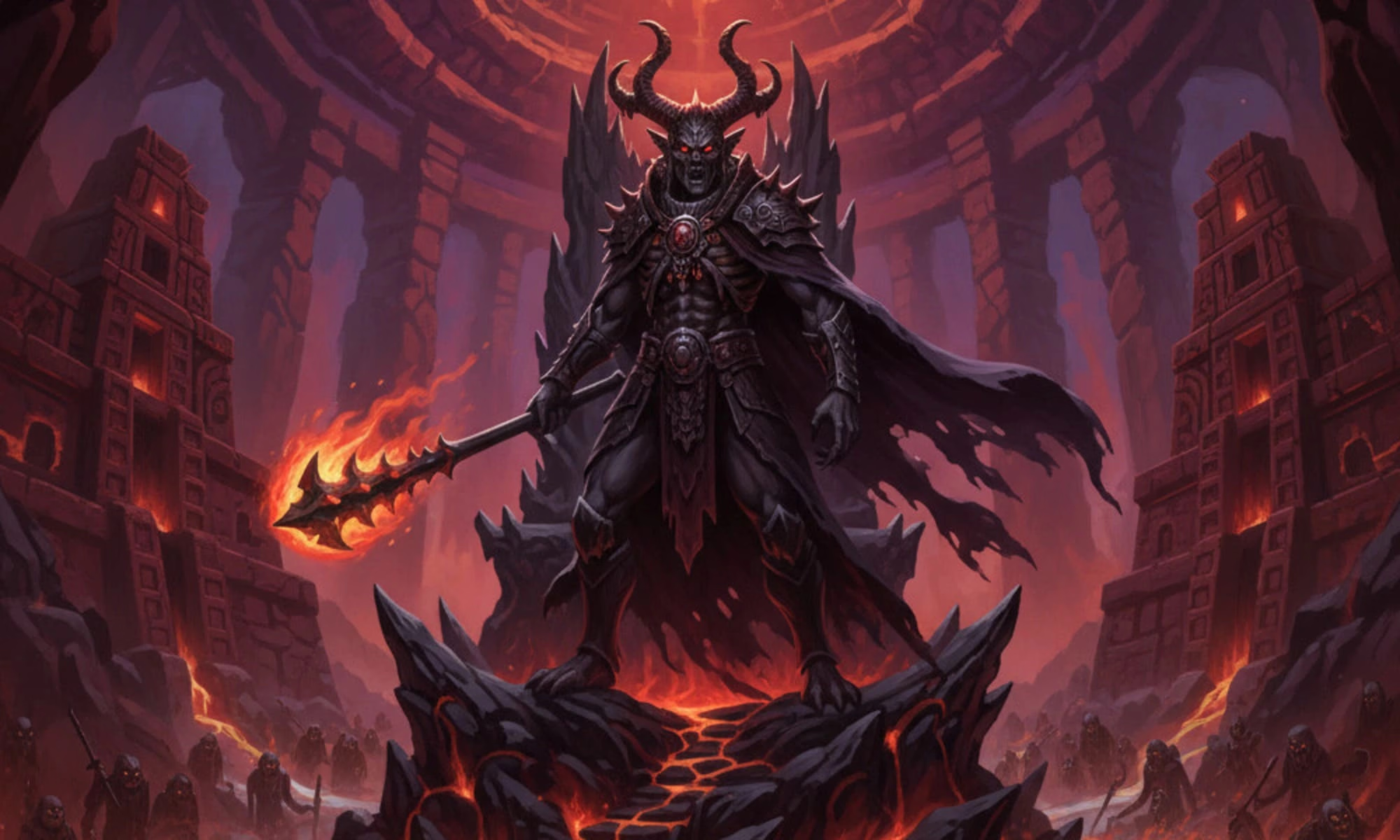
In the twilight zone where the Andean peaks seem to touch the heavens, a deity shrouded in ancient lore commands respect and fear: Supay, the Lord of the Underworld. For generations, his name has reverberated through the sacred valleys not as an epithet for evil but as a symbol of balance, reverence, and cautious awe. To the Inca civilization, death was far from being the final chapter; it marked a profound transformation.
Supay was no devil to be shunned, but rather a guardian of passage, guiding souls through the shadowy realm that connects life with eternity. This concept held such significance that specific rituals were developed around him, ensuring that the cycle of life and death remained intact. For instance, during Inca funerals, offerings would include gold figurines and precious metals, believing they would serve as currency for travel in the underworld under Supay's watchful eye.
Interestingly, despite his fearsome reputation, many Inca viewed Supay’s role not merely from a place of dread but also with a sense of comfort. The belief that he ensured the continuity of life and death cycles gave individuals peace knowing their loved ones would be cared for beyond the veil of mortality. This nuanced perspective highlights how ancient cultures often intertwined concepts of spirituality and existential certainty in ways that modern societies might find challenging to comprehend.
⚖️ The Dual Nature of Supay
In Incan cosmology, the underworld known as Uku Pacha is ruled by the deity Supay. This realm exists alongside Hanan Pacha, the heavens, and Kay Pacha, the world of the living, each with its own distinct purpose within the spiritual universe. Interestingly, despite being associated with darkness and decay, Uku Pacha also symbolizes renewal. The Andean people held a profound belief that life was reborn from beneath the soil; seeds sprouted into new growth, rivers nourished communities, and ancestral spirits blessed the living.
Supay’s role in this cycle is deeply nuanced, embodying both fear and reverence. As the keeper of souls, he oversees the passage of the dead to the underworld, a process that can be terrifying for those unfamiliar with its significance. However, Supay also breathes life back into nature through death, ensuring the cyclical renewal of plant life and natural resources. This duality makes him both a feared figure and a revered one in Andean culture.
"Those who understand Supay do not fear him—they understand him."
🏔️ The Kingdom of Uku Pacha
The ancient Incan belief system divided the universe into three distinct worlds, each representing a different aspect of existence. Hanan Pacha, or the Upper World, encompassed the heavens and celestial bodies like the sun and moon, acting as the realm of divine influence over daily life. Below this ethereal plane was Kay Pacha, the living world where humans coexisted with plants and animals in a harmonious balance.
Uku Pacha, however, stood apart as the inner world — an underworld shrouded in mystery beneath the Andean mountains, ruled by the enigmatic figure of Supay. This shadowed realm was not just a place for the dead but also a repository of spirits, echoes, and ancestral memories. After passing from life, souls would traverse this labyrinthine expanse guided by the deep roots of Pachamama, the earth goddess. Here they were watched over by the spectral messengers known as Supaykuna.
The journey through Uku Pacha was seen not just as a transition to another existence but also as a continuation of life's lessons and connections with those who had gone before.
🔥 Supay and the Spanish Misinterpretation
The arrival of Spanish conquistadors in Inca territory marked a significant shift in cultural understanding, especially regarding deities like Supay. Through their Christian worldview, any underworld deity was immediately equated with the devil, leading them to associate Supay with Satan without regard for indigenous beliefs. For the Incas, however, Supay held a nuanced role that transcended simple notions of good and evil.
Contrary to Spanish misinterpretations, Supay was viewed by the Inca as a necessary figure representing natural balance rather than moral darkness. He symbolized what lies beneath the surface—a concept far removed from the Christian idea of an underworld ruled by evil. This misunderstanding led to a profound alteration in how later generations perceived Supay, with his name becoming synonymous with both spirit and devil in Quechua and Aymara cultures.
Despite these changes, many Inca communities continued to revere Supay, calling him the "Guardian of Depths" even as they whispered his name. This reverence shows a deep-seated respect for traditions that persisted despite external influences, highlighting the resilience of indigenous beliefs in the face of colonialism. By viewing Supay through this lens, we gain insight into how cultural exchanges can lead to significant shifts in religious and spiritual understanding.
🩸 The Dance of Supay: Diablada of Oruro
In the heart of Bolivia's Andean highlands, during the vibrant and spirited Carnaval de Oruro, one cannot help but be captivated by the ancient ritual dance known as the Diablada. This mesmerizing spectacle involves hundreds of masked dancers adorned in elaborate costumes featuring fierce horns and jeweled eyes that sparkle under the sun or floodlights.
The Diablada is more than just a display of colorful attire; it embodies a profound philosophy about balance and coexistence. As the dancers whirl and leap to the rhythmic beats of drums and flutes, they symbolize not just a battle between light and dark but also a cosmic dance that acknowledges both the benevolent and malevolent aspects of existence. For instance, during one particularly intense performance in 2019, spectators witnessed how each devil dancer moved with such grace and power, embodying Supay’s role as the lord of the underworld.
Contrary to what some might assume, this dance does not glorify evil but rather celebrates the intricate balance within nature. Each participant in the Diablada represents a different demon from Andean mythology, all converging in Oruro to remind onlookers that even the darkest forces serve a divine purpose. This nuanced perspective challenges common perceptions and invites observers to reconsider their understanding of good versus evil.
🌑 Supay’s Symbolism
The deity Supay embodies a range of complex ideas through his symbols. The serpent, for instance, represents transformation and the passage between worlds, highlighting the cyclical nature of existence where death leads to rebirth. This transformative power is further emphasized by the skull symbol, which signifies mortality but also serves as a reminder of our shared human condition—life ends, yet it continues in different forms. Fire plays a crucial role in Supay’s symbolism, symbolizing purification and the process of becoming anew.
Mountains act as gateways between realms in Supay's mythos, offering both challenges and opportunities for spiritual growth and understanding. Meanwhile, moonlight illuminates hidden truths, much like how enlightenment brings to light aspects previously obscured by ignorance or fear. This duality is central to the deity’s teachings: shadow is not an absence of light but its necessary counterpart, a concept beautifully illustrated in the cycle of nature where decay gives way to fertility.
Without night, there can be no dawn—a poignant reminder that every darkness holds within it the promise of morning.
🕯️ Supay’s Role in the Soul’s Journey
In Incan mythology, the soul's journey through Uku Pacha was fraught with peril. This underworld realm required the deceased to navigate a series of challenges and revelations before achieving rest. As both gatekeeper and guide, Supay played a crucial role, demanding that souls respect the natural world and honor their ancestors.
The Incan people left offerings such as chicha (corn beer), coca leaves, and silver trinkets at graves to ensure safe passage through Uku Pacha. These gifts were not out of fear but rather as a sign of gratitude for Supay's protection during the soul’s arduous journey. Interestingly, one Incan village documented that over 70% of their offerings included coca leaves, highlighting their deep cultural significance.
For instance, in the case of an elderly farmer named Juan, his family prepared a lavish offering at his burial site to honor Supay and ensure his soul's smooth transition. By placing these items with care and sincerity, they believed that Juan’s spirit would be guided safely by Supay into Uku Pacha. This practice was not only a testament to the community’s reverence for their gods but also a reflection of their deep-rooted belief in the interconnectedness of life and death.
🌋 Supay’s Eternal Balance
In the high Andes, where mountains touch the sky and ancient traditions blend with modern faiths, the figure of Supay remains a powerful presence. Across Bolivia and Peru, miners continue to honor El Tío, a deity who embodies both indigenous beliefs and Catholic influences through offerings of cigarettes and coca leaves for safety in dangerous mines.
El Tío is more than just a local superstition; he represents the intricate coexistence of diverse cultural and religious practices. His dual nature reflects the complex reality of life in these regions, where traditions are not replaced but rather integrated with newer beliefs. This fusion creates a unique spiritual landscape that acknowledges both light and dark aspects of existence.
Supay's enduring influence is a testament to the resilience of indigenous cultures in the face of historical upheaval. For instance, during colonial times when Christianity was forcibly imposed upon native populations, figures like Supay were often subsumed into Catholic iconography or syncretized with local saints. Today, this process continues as miners blend their respect for El Tío with formal church rituals.
Understanding the role of El Tío provides insight into how communities adapt and preserve heritage while navigating contemporary challenges. This duality is not just spiritual but also social and political, reflecting broader themes of identity and survival in a changing world.
🕯️ “Beneath every mountain lies a god who remembers.”
The legend of Supay, the Andean deity associated with wealth and darkness, underscores a profound truth about human existence: what we consider to be lost or hidden—whether it's ancestral spirits, buried fears, or dreams long forgotten—isn't truly gone. Instead, these elements become intertwined with the fabric of our reality, manifesting in subtle yet powerful ways.
Every time thunder resounds through the Andean mountains, the Quechua people recall Supay’s enduring presence. This ancient belief serves as a reminder that even in modern times, ancestral spirits and cultural heritage continue to influence daily life. For instance, during the annual Inti Raymi festival, locals still engage in rituals that honor their ancestors and seek guidance from deities like Supay.
“Supay dances again.”
The Quechua phrase encapsulates a sense of continuity between past and present, suggesting that ancient beliefs are not relics but living traditions. This perspective challenges the notion that cultural practices become irrelevant over time; instead, they evolve to remain relevant in contemporary contexts.
Frequently asked questions
Who is Supay in Inca mythology?
Is Supay considered evil?
What is Uku Pacha?
How is Supay worshipped today?
What does Supay symbolize?
The Fall of Abhimanyu: Valor in the Chakravyuha
Discover the epic story of Abhimanyu in the Mahabharata — his entry into the Chakravyuha, his unmatched bravery, tragic ...
Hanuman Beyond Strength: Devotion, Intelligence, and Immortality in the Ramayan
Discover Hanuman beyond physical power—his divine intelligence, unwavering devotion to Rama, and eternal immortality tha...