Sekhmet: The Lioness Goddess of War and Healing
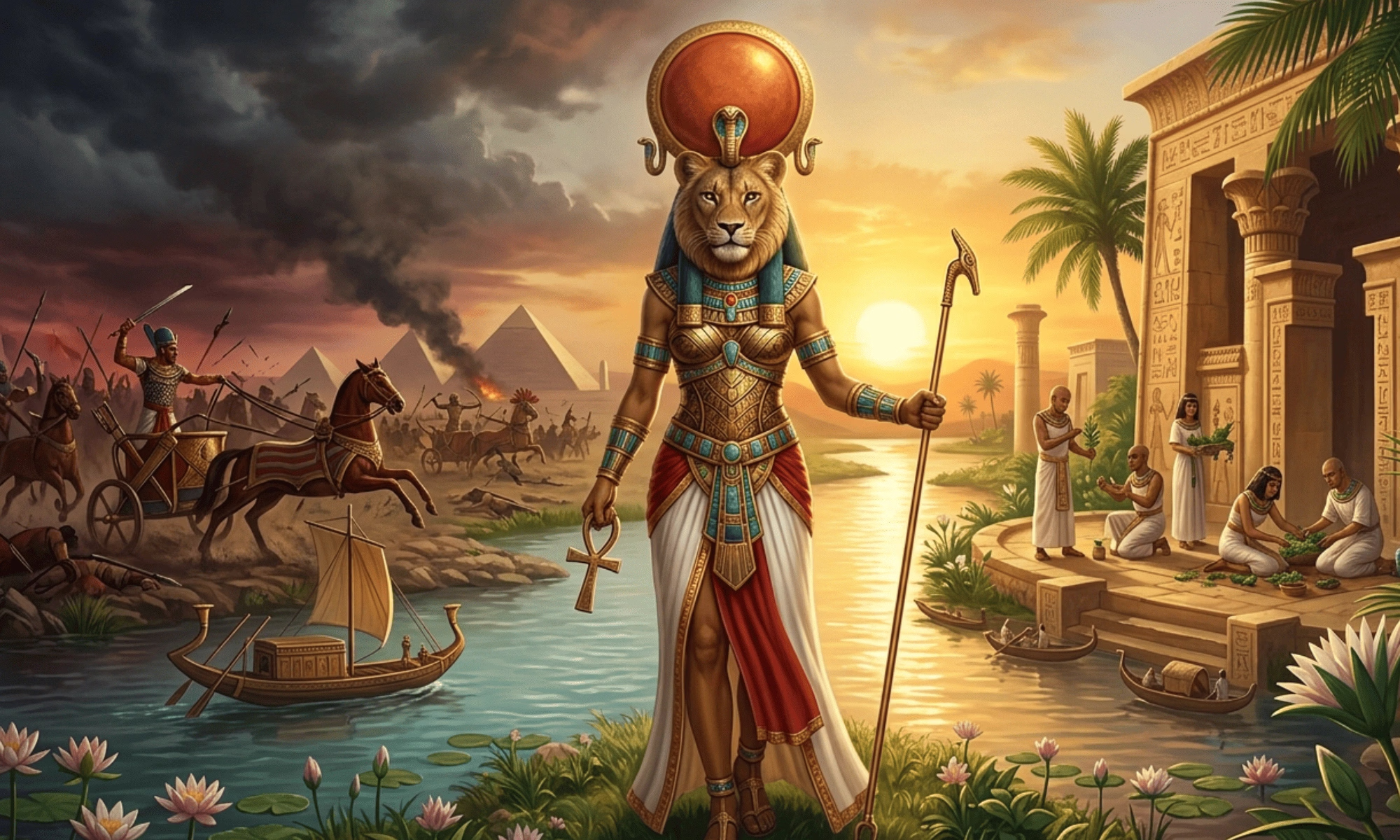
The Goddess Whose Breath Created the Desert
Among the many gods and goddesses of ancient Egypt, few inspired as much awe and fear as Sekhmet. She was the lioness-headed goddess whose roar echoed across battlefields and whose fury could bring kingdoms to ruin. Yet the same deity whose wrath terrified mortals was also revered as a healer, protector, and guardian against disease. In Sekhmet, the Egyptians saw a profound truth about the universe—that destruction and healing were not opposites, but two sides of the same divine power.
Her name means "The Powerful One," and to generations of Egyptians, she embodied exactly that. Kings prayed to her before marching to war, priests invoked her blessings against plague, and ordinary people sought her protection in times of danger. She was not merely a goddess of violence. She was the fiery force that defended cosmic order itself.
Among all the daughters of Ra, none possessed a spirit as fierce or a heart as complex as Sekhmet.
Born from the Eye of Ra
Ancient Egyptian myths tell that when humanity grew arrogant and rebelled against the gods, Ra, the great sun god, became enraged. Though old and weary, his power remained unmatched, and he decided to punish mankind for its disobedience. From his blazing eye emerged Sekhmet, born not from flesh but from divine fury itself.
Descending upon the earth like a storm, the lioness goddess unleashed destruction upon those who had forgotten their place in creation. Her claws were swift, and her thirst for blood seemed endless. Entire lands trembled beneath her wrath, and soon even Ra himself began to fear the terrible force he had created.
Sekhmet's rage had become so overwhelming that it threatened not only the guilty but the balance of the world itself. What had begun as punishment risked becoming annihilation.
And so the creator faced a dilemma: how could even the sun god stop the fury of his own daughter?
The Day the River Turned Red
Unable to command Sekhmet directly, Ra resorted to wisdom rather than force. He ordered thousands of jars of beer to be dyed red with pomegranate and ochre, making the liquid resemble blood. During the night, the fields where Sekhmet planned to continue her slaughter were flooded with this crimson drink.
At dawn, the goddess saw what she believed was a vast river of blood.
Delighted, she drank deeply.
But it was not blood.
The intoxicating drink caused Sekhmet to become calm and peaceful. Her murderous rage faded, and in some traditions she transformed into Hathor, the gentle goddess of love and joy. Through this act, destruction gave way to compassion, and balance was restored to the world.
The Egyptians celebrated this story through festivals filled with music, dancing, and ceremonial drinking. To them, the tale carried a powerful message. Even divine anger must eventually yield to harmony, for chaos without restraint threatens all creation.
Mistress of War and Protector of Kings
Though her wrath had been calmed, Sekhmet never lost her role as the protector of Egypt. Pharaohs regarded her as a divine guardian who marched before their armies. In inscriptions, she was called "Lady of Slaughter" and "She Before Whom Evil Trembles."
Ancient warriors believed that her fiery breath created the desert itself. During battle, she was said to spread fear among enemies and inspire courage in Egypt's defenders. Kings often compared themselves to lions and claimed Sekhmet's favor to legitimize their victories.
Yet unlike gods who delighted in war for its own sake, Sekhmet represented righteous force. Her power was meant to preserve Ma'at—the sacred principle of truth, order, and balance. Violence, in her eyes, was justified only when used to defend harmony against chaos.
In this role, she became not merely a goddess of battle, but the fierce protector of cosmic order itself.
The Divine Healer
What makes Sekhmet remarkable is that the same goddess associated with plague and destruction was also revered as one of Egypt's greatest healers. Her priests became renowned physicians, studying medicine, surgery, and remedies with extraordinary skill.
To ancient Egyptians, illness and health were deeply connected to the spiritual world. Since Sekhmet could send disease, she also possessed the power to remove it. Her temples became places where prayers for healing were offered, and amulets bearing her image were worn for protection.
People suffering from sickness sought her mercy, believing that only the lioness goddess could turn away the invisible forces causing their pain. In this dual role, Sekhmet embodied a truth understood by many ancient cultures: the power to destroy often carries the power to restore.
Just as fire can consume forests and yet clear the ground for new life, Sekhmet's energy represented both devastation and renewal.
Sekhmet and the Balance of Ma'at
Egyptian civilization revolved around Ma'at, the divine principle of order and balance. Every flood of the Nile, every sunrise, and every ritual performed in the temples served to maintain this cosmic harmony.
Sekhmet's role within this system was essential.
Without her strength, evil and chaos would spread unchecked. Without her compassion, destruction would overwhelm creation. She existed at the delicate boundary between these two forces, ensuring that neither consumed the other.
In many ways, Sekhmet represented the fierce side of justice itself. Like a lioness protecting her cubs, she acted with terrifying power when order was threatened, but she also nurtured and preserved life when peace returned.
Her mythology reminds us that strength and kindness are not contradictions. They are partners.
Legacy of the Lioness Goddess
Centuries passed, empires rose and fell, and the temples of Egypt slowly became silent. Yet Sekhmet's image endured. Thousands of statues depicting the lioness goddess have survived, many commissioned by Pharaoh Amenhotep III, who sought her protection during times of plague.
Today, she continues to fascinate historians, artists, and lovers of mythology. Some see in her a symbol of feminine strength. Others admire her role as both destroyer and healer. Modern spiritual traditions often invoke her as a guardian of transformation and courage.
But perhaps her greatest lesson remains timeless.
Sekhmet teaches that true power is not found in destruction alone. It lies in knowing when to unleash strength and when to show mercy. It lies in defending what is sacred without losing compassion. And it lies in understanding that even the fiercest fire can become a source of healing.
Somewhere beyond the deserts of ancient Egypt, where the sun still rises over forgotten temples and the Nile continues its eternal journey, the Lioness Goddess remains watchful—a fierce guardian whose roar once shook the world, and whose compassion helped preserve it.
Frequently asked questions
Who was Sekhmet in Egyptian mythology?
Why did Ra create Sekhmet?
How was Sekhmet stopped from destroying humanity?
Why was Sekhmet associated with healing?
What does Sekhmet symbolize?
Savitri and Satyavan: Love That Defeated Death
The epic love story of Savitri and Satyavan from the Mahabharata — a tale of devotion so strong that it defeated Yama, t...

Coyote: Trickster and Teacher
Explore the tales of Coyote, the trickster and teacher in Native American mythology. Discover his clever tricks, foolish...