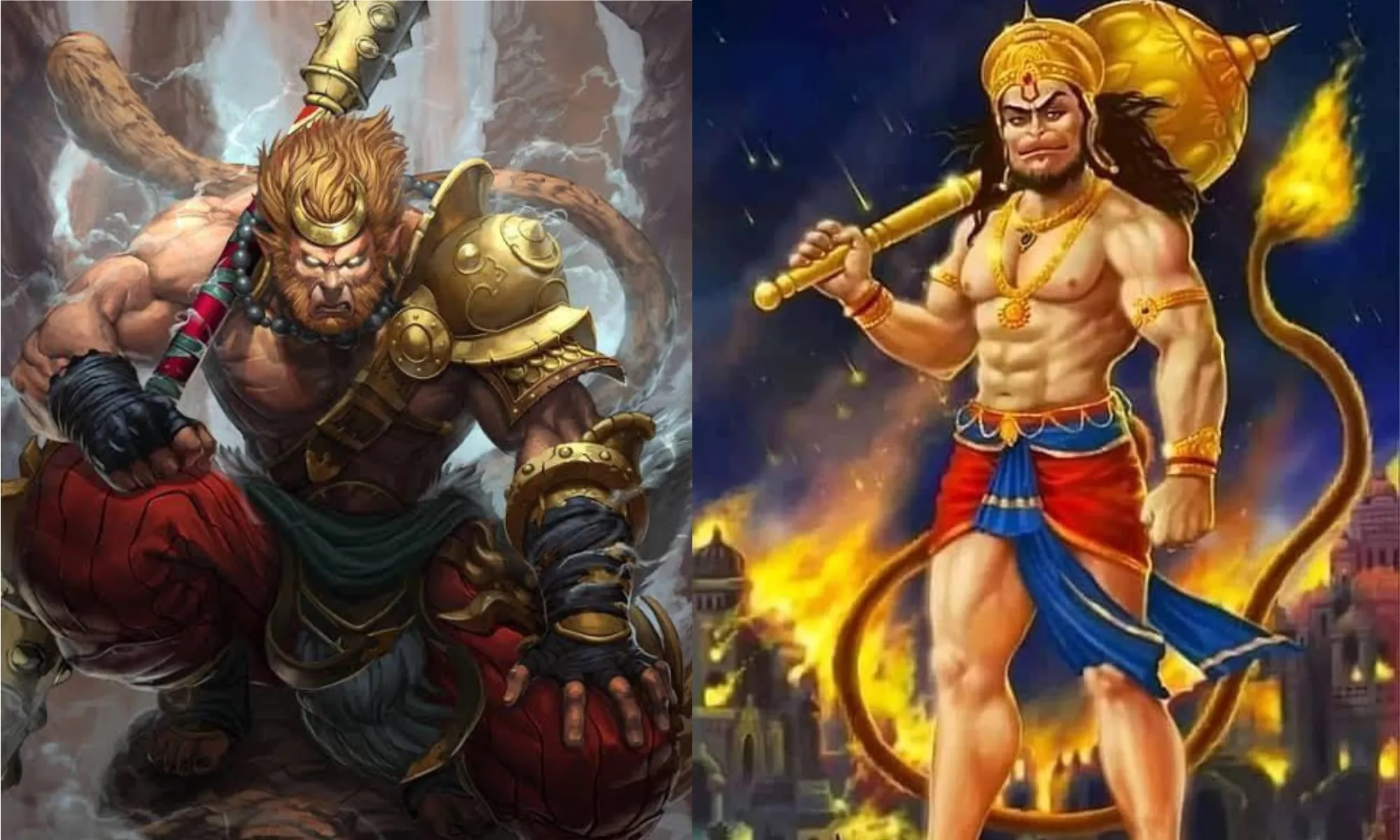
Who won when Vaali fought Lord Hanuman ?
Vaali and his boon
In the ancient Indian epic Ramayana, Vaali emerges as a formidable character—a powerful monkey king ruling over the southern lands. His reign was marked by a remarkable boon granted to him by Lord Indra, which endowed him with an extraordinary advantage in battle: no matter who faced him, half of his opponent's strength would be transferred directly to Vaali. This divine gift rendered Vaali invincible against most foes and solidified his dominance over the monkey kingdom.
However, this boon also set a dangerous precedent, creating an atmosphere of constant vigilance among Vaali's subjects and enemies alike. The other monkeys feared him due to his supernatural power but were also wary of the instability it brought to their society. It was not just about physical strength; it extended to strategic thinking and leadership skills as well. Any challenge to Vaali’s rule required a cunning approach, far beyond mere brute force.
For instance, when Sugriva challenged Vaali for supremacy, he did so with knowledge of the boon's mechanics. Recognizing that open combat was futile, Sugriva devised a clever plan involving an archer and a screen, allowing him to kill Vaali from afar without engaging directly. This intricate maneuver underscores the strategic depth required to counter such divine gifts in ancient warfare. It highlights how even god-given advantages can be neutralized by human ingenuity and tactical acumen.
Ravana's defeat at the hands of Vaali
In a legendary turn of events, Ravana, the mighty king of Lanka, heard about Vaali's formidable strength and sought to challenge him. However, much to his dismay, Ravana was decisively defeated by Vaali in their epic confrontation. This victory filled Vaali with arrogance and hubris; he began boasting loudly that no warrior on earth could surpass him. His newfound confidence led him to issue frequent challenges to other warriors, easily overpowering those who dared to face him.
As word of Vaali's invincibility spread across the land, fewer and fewer warriors were willing to risk their lives against him. One such notable instance involved a renowned warrior named Kuntikeya, who was known for his exceptional combat skills but hesitated to engage Vaali due to the latter’s overwhelming power. This period of unchallenged dominance saw Vaali's reputation grow, making it even more daunting for potential opponents to muster the courage or capability to face him.
Vaali's victory over Ravana did not just elevate his status as a warrior but also marked the beginning of an era where his invincibility seemed unquestionable. This narrative highlights how power and ego can create an unassailable reputation, often deterring potential challengers from attempting to prove otherwise.
Belligerent Vaali challenges Hanuman
One fateful day, while Lord Hanuman was engaged in deep meditation, reciting the name of his master Lord Rama, he encountered a proud and belligerent demon named Vaali. Vaali's arrogance got the better of him as he challenged Lord Hanuman to a fight, convinced that he could overpower the mighty monkey deity. This challenge did not provoke anger in Lord Hanuman but instead elicited a calm smile, which only served to enrage Vaali further. With his ego inflamed, Vaali declared his intention to defeat not just Hanuman but also Rama himself.
The next day, as both combatants prepared for their duel, the atmosphere was charged with tension. Vaali's boastful nature had put him at odds with a being of immense power and divine favor. However, Lord Hanuman remained unperturbed by the impending conflict, focusing on his spiritual connection to Rama. Despite Vaali's bravado and physical prowess, he failed to recognize the unwavering strength that came from Lord Hanuman’s devotion.
In this encounter, Vaali underestimated the importance of faith and dedication in the face of sheer might. His overconfidence was a stark contrast to the humble demeanor of Lord Hanuman, who relied on his spiritual bond with Rama rather than just physical prowess. This tale serves as a reminder that true strength lies not merely in physical capabilities but also in inner resolve and divine support.
Why did Lord Brahma Intervene ?
In a pivotal moment during the impending clash between Lord Hanuman and Vaali, divine intervention occurred as Lord Brahma, the Creator, appeared amidst celestial light. This intervention was swift and decisive, with Brahma instructing Hanuman to restrain his immense power to just one-tenth of its full potential and offer the rest back to his lord. Hanuman complied immediately, adhering to this sacred directive.
With only a fraction of his might, Vaali, who had been granted half of Hanuman's strength through divine favor, found himself in excruciating pain. The sheer power coursing through him caused physical distress and fear, illustrating the perilous nature of unchecked divine energy. His heart raced uncontrollably as he feared his body would break under the strain, highlighting the critical need for moderation when dealing with such immense forces.
Recognizing the gravity of the situation, Lord Brahma intervened once more, urging Vaali to flee if he wished to survive. He emphasized that proximity to Hanuman's overwhelming strength was a death sentence and advised immediate escape. Seizing this advice, Vaali fled at top speed until Hanuman’s power faded entirely within him. Reflecting on his journey, the exhausted Vaali came to understand the enormity of his mistake in challenging such an overwhelmingly powerful being.
Vaali realizing his mistake
After making a grave error, Vaali sought out Lord Hanuman to offer an earnest apology. Known as an incarnation of Lord Shiva, Lord Hanuman held a unique bond with both Vaali and Sugreev, despite the disparity in their divine and mortal statuses. This episode, while not explicitly detailed in the ancient epic Ramayana, has been preserved through centuries of oral storytelling, highlighting the profound impact and reverence for Lord Hanuman.
Lord Hanuman's response to Vaali's mistake exemplifies his compassion and wisdom, qualities that have made him a beloved figure across numerous cultural narratives. This story illustrates not only his immense power but also his capacity for forgiveness and understanding. For instance, when faced with a similar moral dilemma in contemporary contexts, individuals often look up to Lord Hanuman as an embodiment of ethical conduct.
Interestingly, the extent of Lord Hanuman's capabilities remains a topic of endless wonder among devotees and scholars alike. According to some traditions, his strength is believed to be so great that it is nearly limitless, capable of overcoming any obstacle. This nuanced perspective challenges our conventional understanding of divine power as merely physical might, revealing instead a blend of spiritual wisdom and compassionate action.
Frequently asked questions

Hina and the Moon’s Journey – The Goddess Who Sought Eternal Light
Discover the Polynesian legend of Hina, the radiant moon goddess who transcended mortality to find eternal freedom. Expl...

Tawhiri – The God of Storms and Revenge
Discover the epic tale of Tāwhiri, the Māori god of storms and revenge, whose fury shaped the world and whose love for h...