Rostam and Sohrab: The Tragic Battle Between Father and Son
When Destiny Hides the Truth
Among all the tragedies preserved in world mythology, few stories strike the human heart as deeply as the tale of Rostam and Sohrab. Unlike wars fought between lifelong enemies or monsters defeated by legendary heroes, this is a story where the greatest enemy is neither hatred nor ambition—it is ignorance. Two of Persia's mightiest warriors stand on opposite sides of a battlefield, each searching for glory, each fighting with honor, and each completely unaware that the man standing before him is bound to him by blood.
The story comes from the Shahnameh, or The Book of Kings, the monumental Persian epic composed by the poet Ferdowsi around the tenth century. Spanning thousands of years of legendary Persian history, the Shahnameh celebrates heroes, kings, and battles, yet among all its magnificent tales, none is remembered with greater sorrow than the duel between Rostam and his own son. It is a masterpiece of epic storytelling because its tragedy feels painfully human. There is no villain manipulating every event, no curse cast by jealous gods, and no monster waiting to be slain. Instead, fate quietly arranges every step until father and son unknowingly meet as enemies.
Their story has echoed across centuries because it explores one of humanity's oldest fears—that destiny can separate those who belong together, and that truth sometimes arrives only after it is too late.
Rostam — The Greatest Hero of Persia
Long before Sohrab was born, the name Rostam had already become synonymous with heroism throughout Persia. Towering above ordinary men in both stature and reputation, he was the greatest champion ever to serve the kings of Iran. His incredible strength, unmatched courage, and unwavering loyalty made him the protector of the kingdom against invading armies, monstrous creatures, and supernatural enemies.
Mounted upon his legendary horse Rakhsh, Rostam traveled across mountains, deserts, and enchanted lands performing impossible feats that ordinary warriors could scarcely imagine. He defeated dragons, slew demons, rescued imprisoned kings, and survived trials that became legendary throughout Persia. To the people, he was more than a warrior—he was the guardian of civilization itself.
Yet for all his victories, Rostam's greatest challenge would not come from a dragon or an army. It would come from his own family, though he did not yet know it.
A Night That Changed Two Kingdoms
During one of his journeys, Rostam entered the neighboring kingdom of Samangan after losing his faithful horse. There he was welcomed by the local king, whose daughter, the beautiful and intelligent Tahmineh, had long admired the legendary hero. Unlike many princesses of mythology who waited passively for destiny, Tahmineh boldly confessed her admiration and asked Rostam to marry her.
Their union lasted only a single night before duty called the great warrior back to Persia. Before leaving, Rostam gave Tahmineh a precious seal, telling her that if they were blessed with a son, she should give him this token one day so he would know the truth of his heritage.
Neither of them imagined that this small keepsake would become the key to one of mythology's greatest tragedies.
Months later, Tahmineh gave birth to a son named Sohrab, but fearing that powerful kings might use the child against Rostam, she kept the father's identity secret. The boy grew up believing only that his father was one of the greatest heroes who had ever lived.
That mystery would shape the rest of his life.
Sohrab's Dream
From childhood, Sohrab displayed astonishing strength that rivaled seasoned warriors. Before reaching adulthood, he could defeat experienced soldiers with ease, and tales of his courage spread across neighboring kingdoms. Like his father, he possessed extraordinary physical power, but unlike Rostam, his heart was driven by hope rather than duty.
Sohrab dreamed not of conquest for its own sake but of finding his unknown father. He imagined the two of them standing together, overthrowing corrupt rulers, and bringing peace to Persia. To him, discovering Rostam was not merely a personal quest—it was the beginning of a better future for the world.
Unfortunately, ambitious rulers recognized Sohrab's power and manipulated his dreams for their own political gain. They encouraged him to invade Persia, carefully ensuring that father and son remained unaware of each other's identities.
Thus, destiny quietly tightened its grip.
The Battlefield of Fate
When Sohrab's army crossed into Persian territory, panic spread throughout the kingdom. Only one warrior possessed the reputation and strength necessary to stop the young champion.
Rostam answered the call.
Neither man recognized the other.
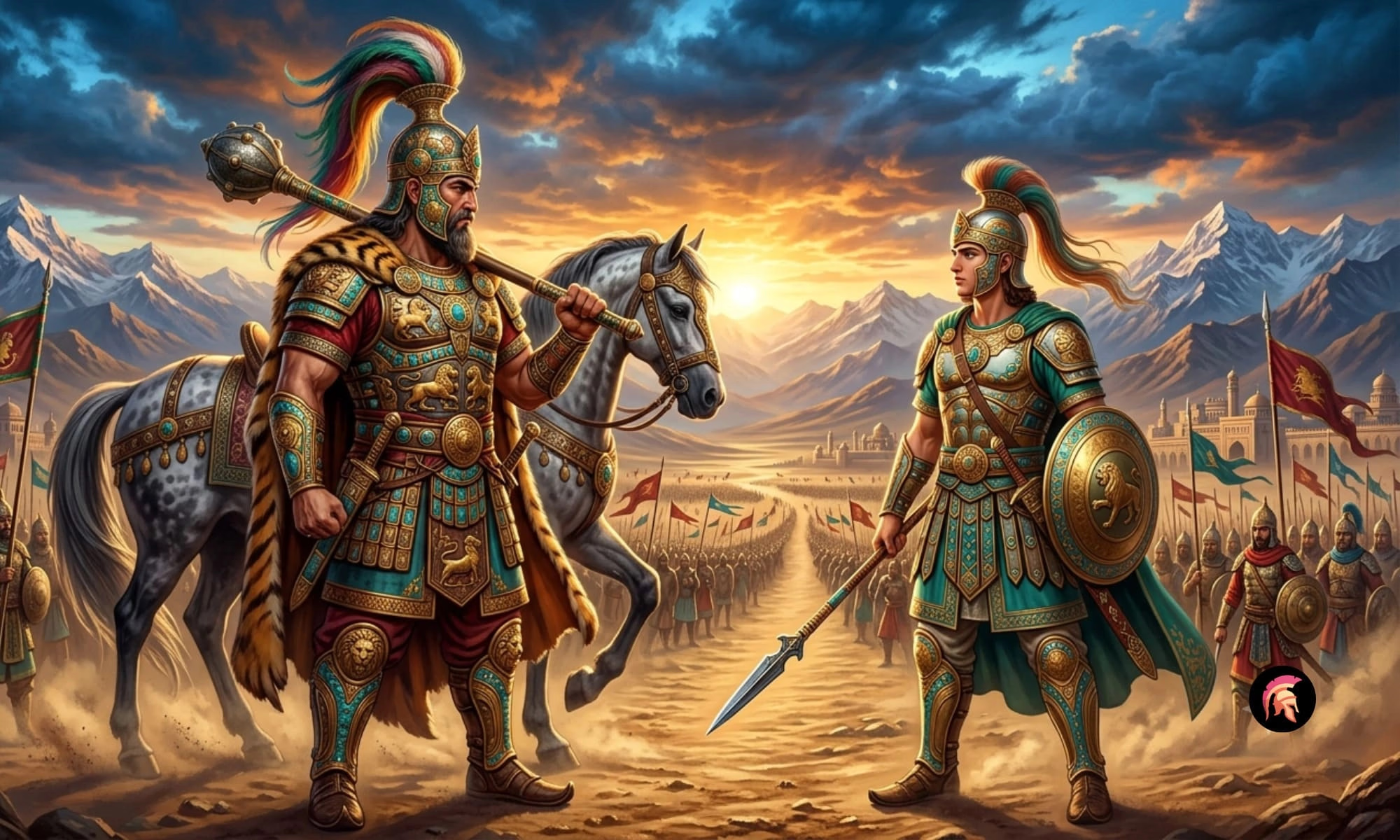
As they approached one another across the battlefield, both felt an unusual respect for their opponent. Sohrab, sensing something strangely familiar about the older warrior, repeatedly asked his identity. Rostam, wary of revealing himself to an unknown enemy, refused to answer directly.
What might have become the happiest reunion in Persian mythology instead became its most heartbreaking misunderstanding.
The armies stepped back as the two greatest warriors of their age prepared to fight.
Their duel would decide not only the battle but also the fate of both their lives.
The Duel That Shook Persia
The clash between Rostam and Sohrab lasted for hours, with neither warrior able to gain a decisive advantage. Their swords shattered shields, their spears splintered upon armor, and the earth trembled beneath their strength. Observers watched in stunned silence as each displayed skill and endurance beyond anything they had ever witnessed.
Unlike many mythological battles where one hero quickly overwhelms another, this duel is remarkable for its balance. Father and son mirror one another in courage, determination, and honor. Every exchange of blows reveals how similar they truly are, even as they remain blind to the truth.
Eventually, experience triumphed over youthful confidence. Rostam managed to seize an opening and delivered a fatal wound to Sohrab.
Only after the battle ended did destiny reveal its cruelest secret.
The Recognition
As Sohrab lay dying, he spoke of the father he had spent his entire life searching for. He revealed the seal his mother had given him—the very token Rostam himself had left behind years earlier.
The moment Rostam saw it, the world around him collapsed.
The young warrior dying in his arms was not merely an enemy.
He was his son.
No victory in Persian history had ever felt so empty. The greatest hero of Iran, who had defeated dragons and demons, fell into despair because he had unknowingly destroyed the person he had always hoped to protect.
Rostam begged for physicians, medicines, and miracles, but fate had already spoken. Nothing could undo what had been done.
Sohrab forgave his father before taking his final breath, asking only that Rostam care for his mother and remember him with honor.
The battlefield that had witnessed legendary heroism now became a place of unimaginable grief.
Why This Story Endures
The tragedy of Rostam and Sohrab is not simply about mistaken identity. It explores timeless themes that remain powerful even today. It reminds us that pride, secrecy, political ambition, and poor communication can destroy even the deepest human bonds. The greatest strength cannot overcome a truth discovered too late.
Unlike many heroic epics that celebrate glorious victories, Ferdowsi chooses to show that even the noblest heroes are vulnerable to fate. Rostam remains a legend, yet his greatest achievement is forever overshadowed by the wound he carries in his heart.
This emotional complexity is one reason why the Shahnameh continues to be regarded as one of the greatest literary works ever written.
Legacy Across Persian Culture
For over a thousand years, the story of Rostam and Sohrab has inspired Persian poets, painters, musicians, dramatists, and storytellers. Miniature paintings often depict the heartbreaking moment of recognition, while theatrical performances emphasize the emotional weight of the final conversation between father and son.
The tale has also found audiences far beyond Iran. Scholars frequently compare it with other tragic family stories from world mythology, such as Oedipus in Greek tradition or the Mahabharata's devastating battles between relatives. Yet Rostam and Sohrab remains unique because its tragedy is born not from hatred but from love delayed by fate.
Even today, their story continues to remind readers that heroism alone cannot conquer destiny, and that sometimes the greatest battles are those fought against ignorance, misunderstanding, and time itself.
Conclusion
The legend of Rostam and Sohrab stands as one of mythology's most heartbreaking masterpieces. It is not remembered because of monsters slain or kingdoms conquered, but because it captures a universal human truth: some wounds cannot be healed by strength alone.
Rostam remained Persia's greatest champion, but the victory that should have secured his legacy instead became his deepest sorrow. Sohrab sought only to find his father, yet destiny placed a sword between them before either could speak the truth.
In the end, the Shahnameh reminds us that greatness is not measured solely by victories on the battlefield. Sometimes the most unforgettable heroes are those who teach us the immeasurable cost of fate, the value of truth, and the enduring power of love even in the face of irreversible loss.
Frequently asked questions
Who were Rostam and Sohrab?
What is the Shahnameh?
Why did Rostam and Sohrab fight each other?
Who wins the battle between Rostam and Sohrab?
What does the story of Rostam and Sohrab symbolize?
The Great Flood: Atrahasis and the Divine Reset
Discover the Mesopotamian flood myth of Atrahasis — the wise man who survived the gods’ wrath and restored balance to cr...
Medusa: The Tragic Gorgon of Greek Mythology – Origins, Powers & Legacy
Discover the full story of Medusa in Greek mythology—her origin, curse by Athena, powers, death by Perseus, symbolism, a...