The Gorgons: Sisters of Terror in Greek Mythology – Origins, Curse, Power & Legacy
Exploring legendary beasts, monsters, spirits, and supernatural creatures.
- 1Fenrir and Jörmungandr: Monsters of Prophecy
- 2The Gorgons: Sisters of Terror in Greek Mythology – Origins, Curse, Power & Legacy (you are here)
- 3Top 10 Deadliest Roman Monsters That Terrified the Ancient Empire
- 4Mayan Monsters & Jungle Spirits: Creatures That Haunted the Ancient Rainforests
- 5Oni, Tengu, and Dark Spirits: Monsters of Japanese Folklore Explained
- 6Terrors of the Ancient Seas: Sea Monsters & Ocean Creatures in Greek Mythology
- 7The Rise and Fall of Roman Giants: Monsters Before the Olympians
- 8The Tale of Yamata-no-Orochi: Eight-Headed Serpent
- 9Divs and Demons of Persian Lore – Evil beings, magical wars, and symbolic meanings
- 10Medusa: The Tragic Gorgon of Greek Mythology – Origins, Powers & Legacy
- 11Top 10 Deadliest Yokai in Japanese Mythology Ranked
- 12Huldra: The Enchanting Forest Spirit of Scandinavian Folklore
🐍 When Beauty Turned to Terror
In the shadowy corners of Greek mythology, where deities wielded unchallenged authority and fate was often cruelly arbitrary, three sisters emerged whose mere existence struck fear into hearts. Known as the Gorgons—beings so terrifying that a glimpse could turn any man to stone—they were not originally creatures of darkness but victims of divine wrath.
Their transformation from innocent maidens into feared monsters reveals a deeper narrative of tragedy and injustice. The Gorgons, Stheno, Euryale, and Medusa, did not start their lives as symbols of evil. They became legends because the world recoiled in fear at the power they embodied—female empowerment, the fluidity of identity, and the relentless fury of divine retribution. One such instance is the tale of Medusa, a once-beautiful mortal who caught Poseidon's eye in Athena’s temple, leading to her transformation into a Gorgon.
Their enduring legacy lies not just in their monstrous form but in the tales of female resilience and the consequences of divine interference.
Who Were the Gorgons in Greek Mythology?
The Gorgons, a trio of sisters deeply entrenched in ancient Greek mythology, were born to Phorcys and Ceto, deities personifying the perilous depths and enigmatic edges of the ocean. Their existence was intertwined from birth, marking them as significant figures within their mythological realm.
The Sisters
Each sister carried a unique moniker that resonated with their distinct characteristics:
- Stheno, named for her unparalleled strength and unwavering resolve;
- Euryale, known for her vast roaming territories and piercing screams that could be heard from afar;
- and Medusa, the only mortal among them, often depicted as a powerful queen with hair entwined with serpents.
In early myths, the Gorgons were guardians of the world's borders, stationed at places where mortals dared not venture. Their role was to protect the unknown and maintain order beyond human reach. This perspective offers a nuanced look at how these beings were initially seen as protectors rather than just harbingers of death.
The Appearance of the Gorgons: Fear Given Flesh
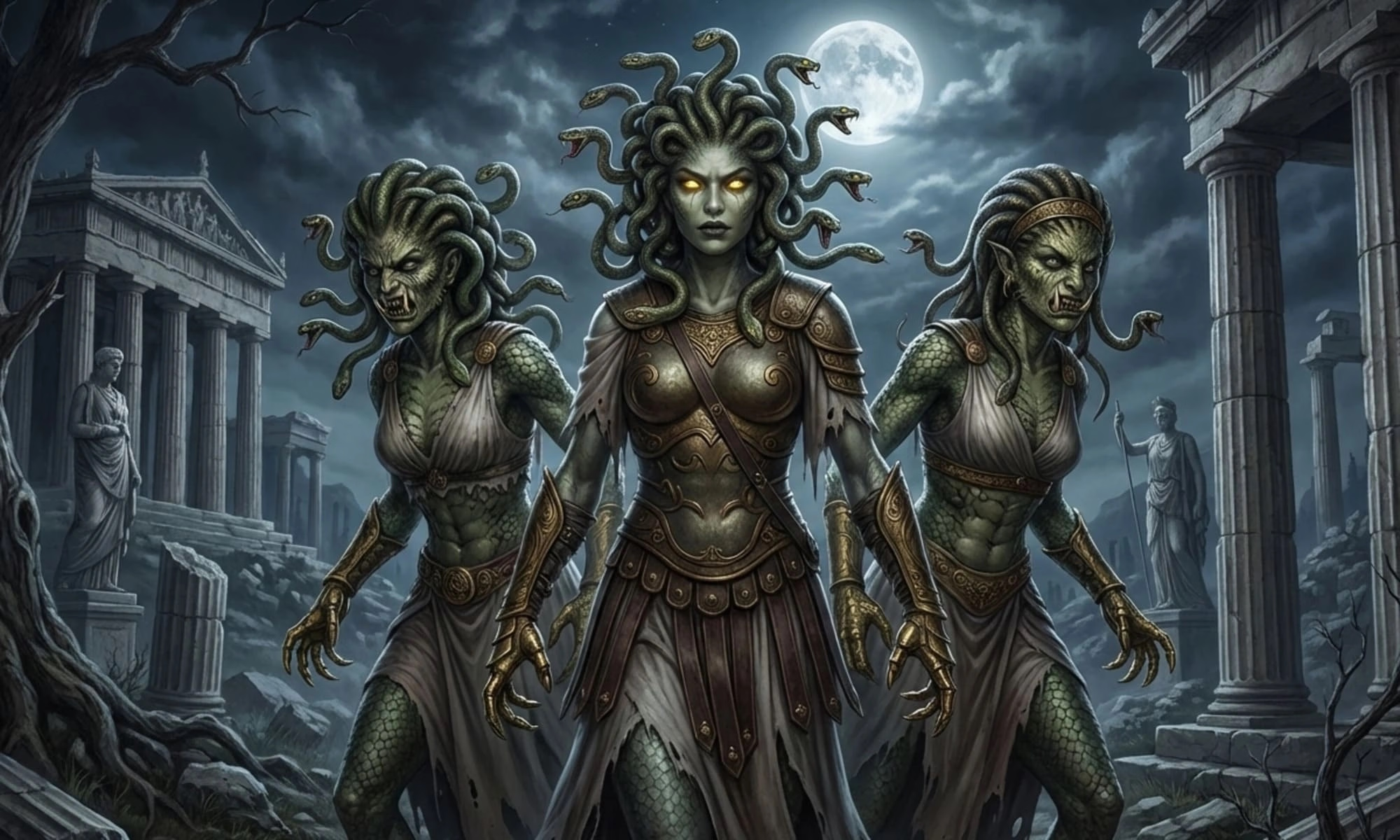
To look upon a Gorgon was to witness fear itself given form. Their hair writhed with living serpents, hissing and striking as though possessed by minds of their own, often leaving onlookers frozen in terror, unable to escape the deadly gaze. The skin, gleaming like bronze or stone, shifted and shimmered in light, adding an eerie dimension to their appearance.
Beyond horror, there was symmetry and ancient beauty—an unsettling reminder that terror and elegance are intertwined. For instance, the black widow spider, with its intricate red hourglass marking against a stark black background, exemplifies this dichotomy between deadly threat and aesthetic perfection.
The Gorgons’ tusks protruded like those of wild beasts, adding another layer to their monstrous presence. Their eyes carried a gaze so powerful it could turn flesh to lifeless stone, representing not just physical transformation but profound psychological impact—the fear of becoming immobile and lifeless in the face of an unyielding threat.
Medusa: The Mortal Sister Who Changed Everything
Among the three Gorgon sisters, Medusa stands out as the mortal one. Ancient tales depict her once as a stunningly beautiful priestess in Athena’s temple, bound by vows of purity and devotion. Her radiant hair was so captivating that both gods and men were drawn to it, seeing her beauty as an unparalleled marvel.
Medusa's tragic story took a dramatic turn when Poseidon violated her within Athena’s sacred temple. Instead of pursuing justice for the god’s indiscretion, Athena punished Medusa by transforming her into a monstrous creature: her once-lustrous hair turned to serpents, and her gaze became lethal. This transformation marked a pivotal shift in how society viewed beauty and virtue, turning them on their heads.
Her tale is a poignant reminder of the power dynamics at play between gods and mortals, where justice often fails those who are vulnerable. For instance, while Poseidon escaped unscathed from his actions, Medusa faced a life sentence of isolation and fear. This twist in her narrative underscores the unfairness that can plague individuals caught in the crosshairs of divine wrath.
Stheno and Euryale: The Immortal Sisters
While Medusa’s tale captivates the imagination, Stheno and Euryale were formidable beings in their own right. Stheno, whose name translates to “the strong one,” was a relentless force on the battlefield. Her ferocity knew no bounds; she could dispatch her enemies with a merciless efficiency that struck fear into the hearts of even the bravest warriors.
Euryale’s scream was equally terrifying, capable of paralyzing soldiers who had faced countless battles. Her voice, echoing across land and sea, was said to strike terror deeper than any blade. The sisters’ immortality set them apart from other mythical creatures; they were invulnerable to weapons and the passage of time. This made their wrath an enduring force, a legacy that continues to be revered in Greek mythology.
Bound by their shared grief over Medusa’s tragic fate, Stheno and Euryale became symbols of relentless vengeance against those who dared enter their domain. Their immortality ensured that this vigilance would endure through the ages, making them iconic figures in tales of retribution and unyielding strength.
The Power of the Gorgons: A Curse That Defied Death
The most notorious power wielded by the Gorgons was their petrifying gaze, a look so terrifying that it could turn any living being into stone. Men, beasts, and even legendary heroes found themselves trapped in a state of eternal horror at the mere sight of these mythical creatures.
More than just a physical transformation, this curse symbolized the ultimate loss of autonomy. It stripped its victims not only of their ability to move but also of their voice and vitality, leaving them as silent, lifeless statues. This power was deeply rooted in the concept of fear—it transformed raw terror into an irreversible state.
Remarkably, even after Medusa's death, her cursed gaze remained potent. Her severed head continued to possess this deadly ability, turning anyone who dared look upon it into stone. This example underscores a profound truth: the curse of the Gorgons was eternal and transcended mortality itself. For instance, Perseus had to use a mirrored shield to slay Medusa without looking directly at her, highlighting the practical and dangerous implications this myth has on our understanding of fear and fate.
Perseus and the Fall of Medusa
Perseus, the legendary son of Zeus, embarked on a daunting quest that was considered beyond human capability. With the support of the gods, he received invaluable tools: Athena gifted him with a mirrored shield to outmaneuver Medusa’s deadly gaze; Hermes supplied winged sandals for swift travel and evasion; and Hades contributed an invisibility helmet to ensure Perseus remained unseen.
Armed with these magical artifacts, Perseus cautiously approached the Gorgons' lair. Instead of a direct confrontation, he used his shield as a mirror to locate Medusa without risking her petrifying stare. In a moment of pure skill and courage, he decapitated Medusa, ending her reign of terror once and for all.
Remarkably, the death of Medusa did not mark the end but rather the beginning of new life forms. From her blood emerged Pegasus, the magnificent winged horse, and Chrysaor, a formidable warrior with divine origins. This unexpected transformation underscores how destruction can give way to incredible beauty and strength, challenging the notion that annihilation leads only to emptiness.
The Wrath of the Surviving Gorgons
When Stheno and Euryale awoke to find their sister Medusa slain, their rage was palpable. The earth itself seemed to shake under the weight of their fury as they set out in pursuit of Perseus, whose name became synonymous with the sound of their terrifying screams.
The Gorgons' wrath was unmatched, but so too were the gifts bestowed upon Perseus by the gods. Armed with a polished shield and winged sandals, he navigated through the skies with ease, evading the relentless pursuit. This divine intervention not only saved his life but also secured him a place in legend as one who outsmarted the seemingly invincible.
Years later, tales of their wrath continued to circulate, leaving a lasting impact on human culture and mythology. Stheno and Euryale remained immortal, their grief and rage becoming a cautionary tale about the consequences of divine retribution. Their existence was a stark reminder that even immortality could not shield against the will of the gods.
The Gorgons as Symbols of Protection and Power
Ironically, the image of the Gorgons shifted from a symbol of dread to one of protection. The Gorgoneion, Medusa’s head, was prominently displayed on shields, doorways, temples, and armor, transforming her visage into a talisman against malevolent forces.
Athena's choice to adorn her aegis with Medusa’s severed head marked the definitive transition from fear to defense. This powerful emblem not only protected but also served as a reminder of divine might, instilling confidence in those who bore it and terror in potential foes. For instance, Greek warriors would often wear necklaces featuring the Gorgoneion, believing that this symbol imbued them with Athena’s protective prowess.
The Gorgons' transformation into guardians highlights a nuanced perspective: fear can be harnessed as a tool for safety and strength. This shift reveals how ancient cultures adapted myths to serve practical purposes, turning a source of terror into a beacon of security.
Cultural Legacy of the Gorgons
The Gorgon myth, particularly Medusa's, has transformed over history. In ancient Greece, they were feared as chaos and destruction personified; Romans viewed them protectively, using their images to ward off evil. This reflects cultural narrative evolution.
Feminist scholars now see Medusa not just as a victim but as a powerful figure embodying women's rage and resilience against systemic injustice. Camille Paglia’s analysis highlights her transformation from passive symbol to agent of change, underscoring the complexity of mythological figures like Medusa, who are both fearsome monsters and potent symbols of empowerment.
A nuanced perspective suggests that monsters aren't born but made by societal conditions and personal experiences. This challenges the idea of innate evil and instead posits that even mythological figures like Medusa can be understood through a social construction lens.
Were the Gorgons Villains or Victims?
The question of whether the Gorgons were villains or victims is complex, mirroring Greek mythology's intricacies. Medusa and others feared for their ability to turn onlookers to stone; yet, gods banished them to isolated regions, far from human protections. This isolation bred desperation and self-defense, leading them to punish intruders.
Deeper into the Gorgons' tale reveals they were neither purely evil nor completely innocent. Wronged by powerful deities who saw them as tools rather than sentient beings, this raises questions about societal power structures and how those at the margins are often forced into villainous roles due to systemic neglect and abuse.
Consider modern scenarios where marginalized communities resort to extreme measures because they feel abandoned by society's legal and ethical frameworks. Like the Gorgons, these individuals may appear as aggressors but reveal themselves as victims of institutional failures upon closer inspection. This perspective challenges us to reevaluate our assumptions about who is truly at fault in situations lacking justice.
The Enduring Terror of the Gorgons
In Greek mythology, few figures evoke enduring fear and fascination as the Gorgons. Their image of Medusa, with writhing snakes for hair and ghastly visage, has captivated audiences for centuries, inspiring art, literature, and popular culture. Embodiments of terror, tragedy, and transformation, their story highlights intense suffering turned to stone—a fate that struck fear into ancient Greeks who believed encountering a Gorgon meant certain death. This mythological concept resonates with modern audiences through its exploration of duality and the transformative power of facing fears.
To look upon a Gorgon is to confront the darkest parts of oneself,
Such paradoxical allure has made them symbols of dread and resilience, transformation. Perseus' tale of beheading Medusa with Athena’s shield exemplifies facing one's fears through ingenuity and courage, echoing in countless works that add layers to their timeless legacy.
Frequently asked questions
Who were the Gorgons in Greek mythology?
How many Gorgons were there?
Why is Medusa different from her sisters?
Did all Gorgons have the power to turn people to stone?
Why did Perseus kill Medusa?
What happened to Stheno and Euryale after Medusa died?
What do the Gorgons symbolize in Greek mythology?

Ragnarok: The Long Winter
What are the event that lead to and took place during Ragnarok: The Long Winter from Norse Mythology ? Who are all the g...
Samudra Manthan: The Churning of the Ocean and Its Cosmic Treasures
Explore the legendary story of Samudra Manthan, the cosmic churning of the ocean by gods and demons, and discover its sy...