Cernunnos: Lord of the Forest and Wild Beasts
The Mysterious Horned God of the Celts
Long before cathedrals rose across Europe and kingdoms carved borders upon the land, the ancient forests of Gaul and Britain were alive with whispers. Beneath towering oaks and beside rivers hidden by mist, the Celtic peoples believed that divine spirits walked among animals and trees. Among these sacred beings, one figure stood apart—a god whose image has survived not through epic poems or lengthy legends, but through symbols carved in stone and fragments of ancient memory.
His name was Cernunnos.
Unlike the thunder gods and warrior kings that dominate many mythologies, Cernunnos ruled over quieter realms. He was the lord of forests, guardian of wild creatures, master of fertility and abundance, and the mysterious bridge between civilization and the untamed world. Though much about him remains hidden in the shadows of history, his image continues to captivate people more than two thousand years later.
With the antlers of a stag and the calm presence of a sage, Cernunnos embodied the spirit of nature itself—powerful yet peaceful, wild yet nurturing.
The God with the Antlers of the Stag
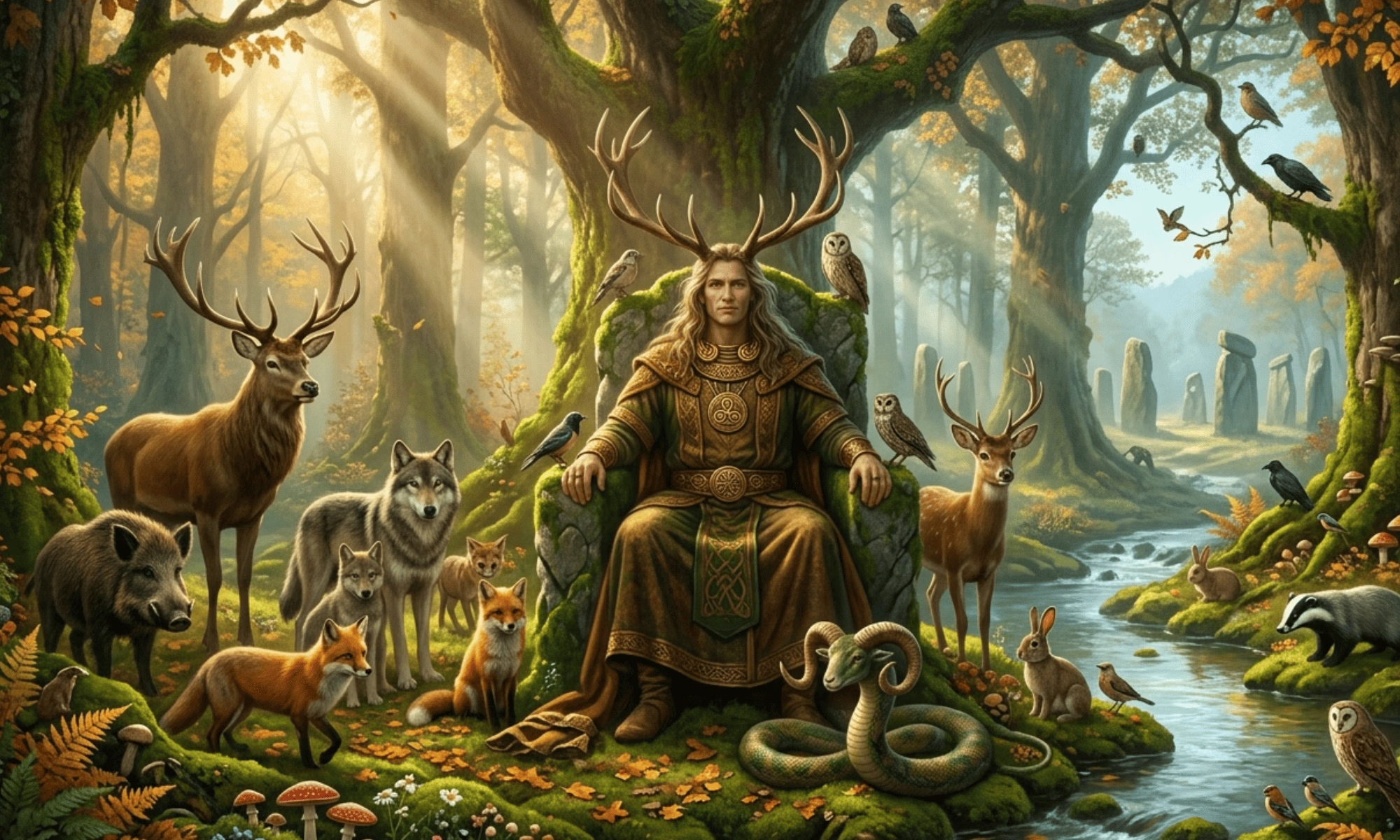
One of the most famous depictions of Cernunnos appears on the Gundestrup Cauldron, a remarkable silver artifact discovered in Denmark. There, the horned god sits cross-legged, surrounded by animals and holding sacred objects. His antlers rise proudly above his head, resembling those of a mighty stag.
To the Celts, antlers symbolized renewal and the cycle of life. Every year, deer shed and regrow their antlers, making them powerful symbols of death and rebirth. By bearing these antlers, Cernunnos became a representation of nature's eternal rhythm.
He is often shown holding a torc, a sacred neck ring associated with nobility and divine authority, while a ram-horned serpent coils beside him. Around him gather wolves, stags, bulls, and other creatures, all existing peacefully in his presence.
Unlike rulers who commanded through force, Cernunnos ruled through harmony. His power came not from domination but from balance.
Guardian of Wild Beasts
To the Celtic peoples, forests were not empty wilderness. They were sacred realms inhabited by spirits, animals, and gods. Hunters entering the woods understood that they stepped into the domain of Cernunnos.
He watched over all creatures, from mighty stags to humble rabbits. Predators and prey alike fell under his protection, emphasizing that every part of nature held its place within the cosmic order.
Ancient Celts depended on the forests for survival. They hunted game, gathered herbs, and revered the great trees that sheltered them. Through Cernunnos, they recognized that humanity was not separate from nature but merely one part of a larger web of life.
His presence reminded people that abundance came not through conquest but through respect. The wild world was not an enemy to be tamed, but a sacred gift to be honored.
Lord of Fertility and Prosperity
Though Cernunnos is most closely associated with animals and forests, he was also connected to fertility, wealth, and abundance. In Celtic thought, prosperity was deeply intertwined with the natural world. Healthy forests, fertile fields, and thriving herds all represented divine blessings.
Many scholars believe that Cernunnos governed the life force that flowed through plants, animals, and humans alike. His symbols often include bags of coins, grain, and serpents—images associated with renewal and prosperity.
Unlike gods who bestowed riches through warfare or conquest, Cernunnos offered wealth through balance and harmony with the land. He represented a world in which humanity flourished by living alongside nature rather than exploiting it.
His blessings extended beyond material prosperity. He symbolized spiritual abundance as well—the understanding that true wealth lies in living in harmony with the cycles of life.
The God of the Threshold
Perhaps the most fascinating aspect of Cernunnos is his role as a being who existed between worlds.
He stood between civilization and wilderness.
Between man and beast.
Between life and death.
Between order and chaos.
Many scholars see him as a liminal deity, a guardian of thresholds and transitions. The ram-horned serpent that frequently accompanies him symbolizes transformation and rebirth, while his antlers connect him to the changing seasons.
In this sense, Cernunnos was not merely a forest god. He represented the hidden connections that bind all things together. The ancient Celts understood that life itself exists in constant motion, forever moving between beginnings and endings.
Cernunnos embodied that eternal flow.
The Lost Myths of Cernunnos
Unlike Zeus, Odin, or Ra, whose stories survive in written texts, the myths of Cernunnos have largely been lost. The Celtic druids relied heavily on oral tradition and rarely recorded their beliefs. As Christianity spread across Europe, many of these stories disappeared.
What remains are fragments—carvings on stone monuments, sacred symbols, and images preserved in artifacts.
Yet this mystery has only deepened his appeal.
Without a single defining legend, Cernunnos has become a symbol open to interpretation. Some view him as a god of fertility. Others see him as a lord of animals or a guardian of the Otherworld. In truth, he may have embodied all these aspects simultaneously.
Like the forests he ruled, Cernunnos remains mysterious, inviting each generation to rediscover his meaning.
Cernunnos and the Green Man
Over the centuries, echoes of Cernunnos may have survived in European folklore. Medieval carvings of the Green Man—faces emerging from leaves and vines—carry themes remarkably similar to those associated with the ancient horned god.
Both figures represent fertility, renewal, and the enduring spirit of nature.
Though direct connections remain uncertain, many modern scholars and spiritual traditions see Cernunnos as part of a broader tradition celebrating humanity's relationship with the natural world.
Today, he is honored by modern Pagans, Wiccans, and those who seek inspiration in ancient traditions. His image has also appeared in literature, fantasy, and popular culture, where the horned god continues to symbolize mystery and the untamed spirit of the wilderness.
Legacy of the Lord of the Forest
Perhaps the greatest lesson Cernunnos offers is one that feels increasingly relevant today.
The ancient Celts understood something modern societies often forget—that humanity does not stand above nature but within it. Forests, rivers, animals, and seasons are not merely resources to be consumed. They are living parts of a greater whole.
Cernunnos reminds us that strength can exist without violence, and power can flourish without domination. He teaches that abundance comes through balance and that wisdom often resides not in cities and monuments, but beneath the quiet canopy of ancient trees.
Though his stories have faded and his temples have vanished, the spirit of the horned god endures wherever wild places survive.
And perhaps, in the rustling leaves of forgotten forests and the watchful eyes of deer at dawn, Cernunnos still sits upon his moss-covered throne, surrounded by the creatures of the earth, keeping eternal watch over the sacred harmony of the natural world.
Frequently asked questions
Who was Cernunnos in Celtic mythology?
What do Cernunnos' antlers symbolize?
Why is Cernunnos associated with animals?
Are there myths about Cernunnos?
What does Cernunnos symbolize today?
Ragnarök: The End of the Gods and the Dawn of Renewal
Discover the epic tale of Ragnarök — the prophesied end of the Norse gods, the battles of Fenrir and Thor, Loki’s betray...