Tsukuyomi: The Moon God Banished from the Sun
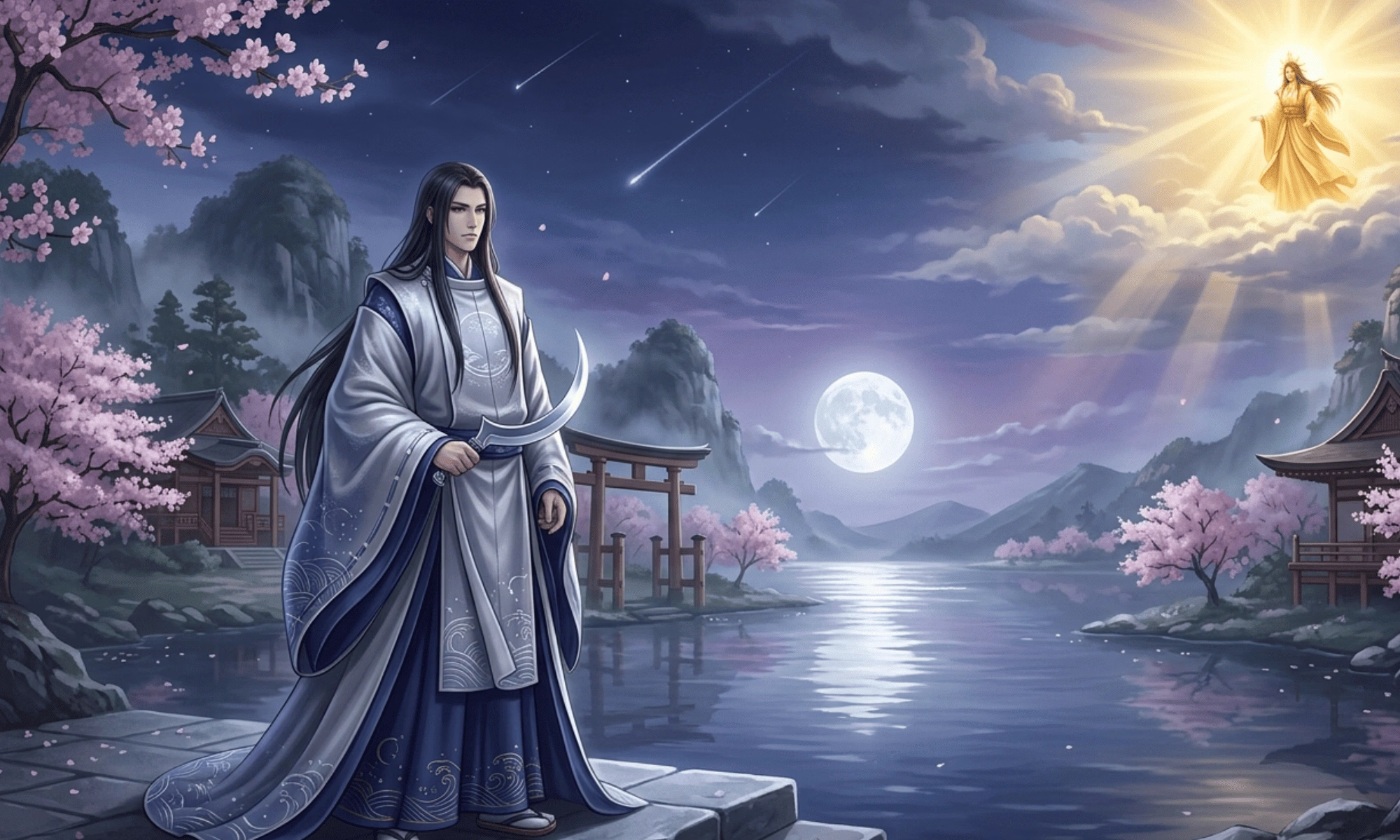
Among the many deities of Japanese mythology, few are as mysterious and elusive as Tsukuyomi, the god of the moon. While his sister Amaterasu, the radiant sun goddess, occupies a central place in Shinto tradition and his brother Susanoo is remembered for his storms and heroics, Tsukuyomi remains a figure wrapped in silence and moonlight.
His story is one of duty, honor, and a single act that changed the heavens forever. Through his actions, day and night became separated, and the moon god found himself exiled from the warmth of the sun.
Unlike many gods who sought glory and worship, Tsukuyomi became the ruler of the quiet hours, forever watching the world from afar, his silver light illuminating the darkness while carrying the burden of eternal solitude.
Born from the Creator God Izanagi
The origins of Tsukuyomi begin with Izanagi, the creator god who helped shape the islands of Japan. After returning from the underworld and cleansing himself of its impurities, Izanagi performed a sacred purification ritual.
As he washed his left eye, the brilliant Amaterasu was born.
From his right eye emerged Tsukuyomi, calm and beautiful, destined to rule the moon and the night.
And from his nose came Susanoo, the wild god of storms and seas.
Together, these three siblings formed some of the most important deities in Shinto mythology. Each governed a realm essential to existence—the heavens, the moonlit night, and the oceans.
Yet among them, Tsukuyomi was always the most mysterious.
Ancient texts speak little of him compared to his siblings, adding to his reputation as a quiet and distant deity whose influence was subtle rather than overwhelming.
Lord of the Moon and Keeper of Night
As ruler of the moon, Tsukuyomi governed the passage of time, the changing months, and the rhythm of the night. In ancient Japan, lunar cycles guided agriculture, religious festivals, and the daily lives of people.
The moon was not merely a source of light. It represented order, reflection, and tranquility.
While the sun revealed the world in all its brilliance, the moon invited contemplation and stillness. Tsukuyomi's realm was one of silence and balance, where dreams and thoughts flowed beneath the silver glow of the night sky.
Unlike gods associated with war or storms, Tsukuyomi embodied restraint and discipline. His presence was gentle, but his authority over the celestial cycles made him indispensable to the harmony of the cosmos.
The Feast of Uke Mochi
The event that forever changed the relationship between the sun and moon began with a divine banquet.
According to the ancient chronicles, Amaterasu sent Tsukuyomi to visit Uke Mochi, the goddess of food and nourishment. She wished to honor the moon god with a feast worthy of the heavens.
Uke Mochi prepared the meal in a miraculous way. Facing the sea, she produced fish from her mouth. Turning toward the forests, she brought forth game and animals. Facing the fields, she created grains and rice.
To the goddess, this was a sacred act of creation and abundance.
But Tsukuyomi saw something entirely different.
To him, the method seemed impure and offensive.
Filled with disgust and anger, the moon god drew his sword and slew Uke Mochi.
The banquet hall fell silent.
And with that single act, the balance of heaven was shattered.
The Wrath of Amaterasu
When Amaterasu learned what had happened, she was horrified.
The sun goddess saw Uke Mochi's miraculous gifts as sacred and life-giving. Tsukuyomi's violence, committed in the name of purity and order, was unforgivable.
In grief and anger, she declared:
"I shall never look upon your face again."
From that moment forward, Amaterasu separated herself from her brother.
Thus, the sun and moon were forever divided.
When one rose into the heavens, the other departed.
Day and night became separate realms, and Tsukuyomi was banished from the company of the sun goddess.
The Japanese people saw in this myth an explanation for one of nature's most familiar rhythms. The moon and sun no longer traveled together because two divine siblings had become estranged.
A God of Silence and Solitude
Unlike Susanoo: Storm God and Heroic Exploits, whose adventures fill countless legends, Tsukuyomi fades into quiet obscurity after his separation from Amaterasu.
This absence is itself meaningful.
The moon does not dominate the heavens as the sun does. It watches silently. It reflects rather than creates its own light. It accompanies solitude and contemplation.
Tsukuyomi became the embodiment of these qualities.
His loneliness transformed him into a god of introspection and hidden wisdom. Under his moonlight, poets composed verses, travelers found their way, and lovers shared quiet moments beneath the stars.
Though separated from the sun, Tsukuyomi continued fulfilling his duties faithfully, governing the cycles of time without resentment or rebellion.
Symbolism of Tsukuyomi
The story of Tsukuyomi carries several layers of symbolism deeply rooted in Japanese culture.
His separation from Amaterasu represents the balance between opposing forces—light and darkness, activity and rest, day and night.
His slaying of Uke Mochi reminds us that rigid adherence to ideals without compassion can lead to tragedy. What Tsukuyomi perceived as impurity, Amaterasu recognized as the miracle of life itself.
The moon itself symbolizes reflection and impermanence. Unlike the constant brilliance of the sun, it waxes and wanes, reminding humanity that all things change with time.
Tsukuyomi's story teaches that even divine beings are capable of mistakes, and that consequences often echo across eternity.
Tsukuyomi in Shinto Tradition
Though not worshipped as widely as Amaterasu, Tsukuyomi remains an important figure in Shinto belief. Several shrines across Japan honor him, especially in regions where lunar cycles held particular significance for agriculture and fishing.
Farmers relied upon the phases of the moon to determine planting seasons, while fishermen observed its rhythms to guide their journeys.
The moon's gentle light became associated with meditation, poetry, and the appreciation of fleeting beauty—a concept central to Japanese aesthetics.
Even today, moon-viewing festivals known as Tsukimi celebrate the beauty of the harvest moon, echoing ancient traditions connected to Tsukuyomi's celestial realm.
Legacy of the Moon God
Though he occupies fewer stories than many gods, Tsukuyomi's influence endures.
He appears in anime, manga, video games, and modern literature, often portrayed as a mysterious and elegant figure cloaked in moonlight. His story continues to fascinate because it speaks to universal themes of misunderstanding, loss, and separation.
Unlike heroic warriors or mighty kings, Tsukuyomi reminds us that solitude can possess its own quiet strength.
He governs the hours when the world grows still, when thoughts deepen, and when dreams take shape.
Conclusion
Tsukuyomi, the moon god banished from the sun, remains one of the most enigmatic figures in Japanese mythology.
Born alongside Amaterasu and Susanoo, he once shared the heavens with his radiant sister. But one act of violence created an eternal divide, giving rise to the separation between day and night.
Though exiled from the light of the sun, Tsukuyomi never abandoned his duty. Night after night, he rises over mountains, forests, and oceans, illuminating the darkness with a calm and gentle glow.
Perhaps that is why the moon has always inspired humanity.
For in its quiet light, we are reminded that even loneliness can become beautiful, and that endings are sometimes simply another phase in the eternal cycle of the heavens.
Frequently asked questions
Who was Tsukuyomi in Japanese mythology?
Why were Tsukuyomi and Amaterasu separated?
What does Tsukuyomi symbolize?
Who are Tsukuyomi's siblings?
Is Tsukuyomi worshipped in Japan today?

Rama Avatar: The Ideal King and Hero of the Ramayana
Discover the epic story of Rama Avatar, Lord Vishnu’s incarnation as the ideal king and hero of the Ramayana. Explore hi...
The Story of Narasimha: Half-Man, Half-Lion Avatar
Explore the story of Narasimha, the half-man, half-lion avatar of Vishnu. Learn about his legend, symbolism, and lessons...