Top 10 Deadliest Yokai in Japanese Mythology Ranked
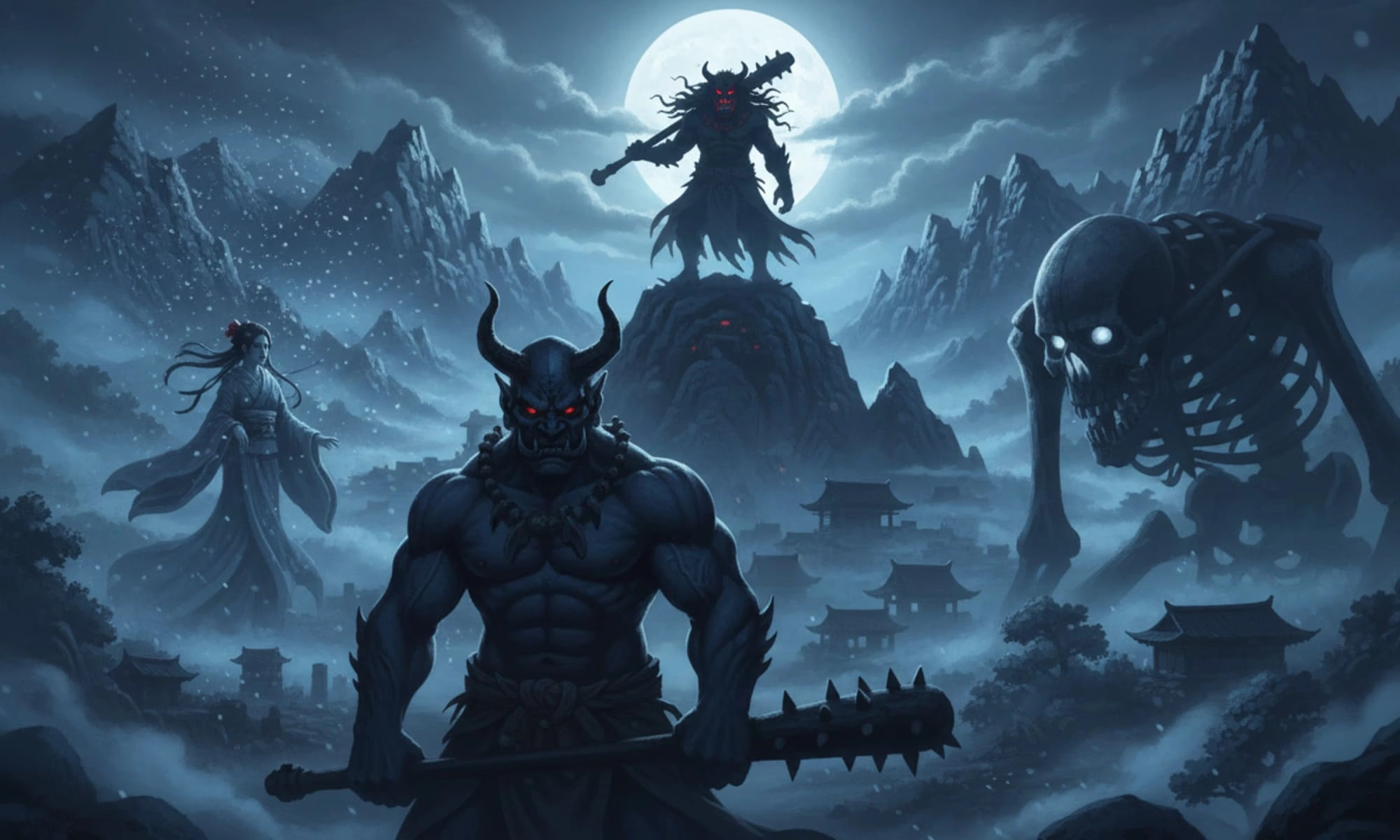
Exploring legendary beasts, monsters, spirits, and supernatural creatures.
- 1Fenrir and Jörmungandr: Monsters of Prophecy
- 2The Gorgons: Sisters of Terror in Greek Mythology – Origins, Curse, Power & Legacy
- 3Top 10 Deadliest Roman Monsters That Terrified the Ancient Empire
- 4Mayan Monsters & Jungle Spirits: Creatures That Haunted the Ancient Rainforests
- 5Oni, Tengu, and Dark Spirits: Monsters of Japanese Folklore Explained
- 6Terrors of the Ancient Seas: Sea Monsters & Ocean Creatures in Greek Mythology
- 7The Rise and Fall of Roman Giants: Monsters Before the Olympians
- 8The Tale of Yamata-no-Orochi: Eight-Headed Serpent
- 9Divs and Demons of Persian Lore – Evil beings, magical wars, and symbolic meanings
- 10Medusa: The Tragic Gorgon of Greek Mythology – Origins, Powers & Legacy
- 11Top 10 Deadliest Yokai in Japanese Mythology Ranked (you are here)
- 12Huldra: The Enchanting Forest Spirit of Scandinavian Folklore
🌑 When the Spirit World Walked Among Humans
In ancient Japan, night brought mystery and danger. Villagers retreated behind paper-thin walls, aware that beyond lay an unseen world where spirits roamed freely. Forests whispered, and every rustle could be yokai—supernatural beings representing fears, natural forces, vengeful spirits, and forgotten souls.
Yokai varied widely in nature and intentions. Some played harmless tricks on humans; others were sinister, capable of spreading illness or death. Legend said speaking certain yokai names aloud could bring dire consequences.
The Deadliest Yokai
Among these entities, the Kuiketsu stands out as particularly dangerous. Associated with disease and death, it appeared at fatal accidents or suicides. Its mere sight caused panic and despair. Interestingly, ancient texts suggest Kuiketsu could serve as a harbinger of change, warning of impending dangers.
🔟 Rokurokubi: The Deceiver in the Dark
The Rokurokubi, a creature from Japanese folklore, appeared as ordinary women during the day but transformed into something sinister at night. Their necks elongated silently, allowing them to enter homes undetected through tiny openings. They preyed on unsuspecting victims discreetly and intimately, often leaving their victims lifeless upon awakening without any trace of violence.
The true danger lay in the Rokurokubi's ability to instill a false sense of security among villagers who trusted them completely during daylight hours. One case involved Kayo, a kind woman known for her dedication. Neighbors heard faint whispers at night but dismissed them as mere coincidences until an old man set up traps and discovered Kayo’s monstrous transformation.
9️⃣ Noppera-bō: The Faceless Terror
The Noppera-bō, a chilling spirit in Japanese folklore, induces paralyzing fear by appearing human from afar but revealing a face devoid of all features up close. Witnesses on desolate roads or abandoned bridges felt overwhelming dread upon seeing this apparition; many died from shock, while survivors endured lasting psychological trauma. Some tales describe the Noppera-bō mimicking familiar faces before transforming into its featureless form, adding another layer of horror as travelers experienced a comforting vision followed by a blank mask. This twist emphasizes the profound psychological impact of facing an identity void.
8️⃣ Jorōgumo: The Seductive Spider
In the dense forests and misty waterfalls of Japan, there lurks a creature both captivating and deadly—the Jorōgumo. This yokai takes on the form of an enchanting woman to lure unsuspecting travelers into its web with sweet music and charming conversation.
As victims fall under her spell, their senses clouded by desire, the Jorōgumo begins to tighten her grip. Conversations turn intimate, and promises of love or adventure draw them closer until they are ensnared not just emotionally but physically as well. "Desire itself could be fatal," warns an ancient legend about the Jorōgumo.
Once entangled, victims find themselves at the mercy of a true spider, with venomous bites and silk that binds tighter than any promise ever could. One tragic tale tells of a young man who ventured too far into the woods to seek solace from life’s trials only to be lured by the Jorōgumo's melody, never seen again.
7️⃣ Ubume: The Spirit of Unfinished Birth
The legend of the Ubume, a ghostly presence from Japanese folklore, arises from a tragic and deeply sorrowful origin. Born out of the pain and anguish experienced by women who died while giving birth, this spirit embodies the unfulfilled dreams and desires that linger after death.
Often seen as a woman dripping with blood, cradling an infant that wails incessantly, she approaches strangers to seek help in holding her child. When someone obliges, they soon realize the true horror; the baby grows impossibly heavy, its weight seemingly infinite and unyielding, pressing down until the rescuer is crushed beneath it.
Contrary to popular belief, Ubume does not attack out of spite or malice but rather as a manifestation of unresolved grief. Her presence serves as a haunting reminder that some deaths leave an indelible mark on the living and refuse to be laid to rest quietly. For instance, in rural Japan during the Edo period, it was believed that seeing Ubume heralded impending misfortune within a community.
6️⃣ Tengu: Masters of Mountain and War
The Tengu, half-man, half-bird mythical creatures, once ruled Japan's rugged mountains as gods and later as dreaded yokai—supernatural beings often seen as malevolent spirits. With martial prowess and illusion-weaving skills, they dominated their territories with an iron grip, abducting monks to test or punish them for arrogance and punishing travelers who entered Tengu territory through misleading or attacking them. While some Tengu protected sacred lands from human interference, others reveled in chaos, showcasing a dual nature of benevolence and malevolence.
5️⃣ Yuki-onna: Death in Falling Snow
The legend of the Yuki-onna, a spectral figure haunting snowy mountains, captivates and terrifies. She appears as pale moonlight, gliding silently through blizzards on frozen paths, enchanting travelers with her ethereal beauty. Yet, this allure is deceptive, for Yuki-onna's chilling presence can end lives instantly; her breath freezes blood and her touch stops hearts.
Some tales tell of moments when death seems to hesitate in the face of Yuki-onna’s power, hinting at a mysterious mercy that occasionally graces those she encounters. This enigmatic quality adds another layer to her myth, making it clear that Yuki-onna is not an embodiment of rage but winter itself, embodying the cold and silent power of the season.
She represents the unpredictable nature of snow and ice, reminding us that beauty can mask danger in ways we least expect. In a particularly chilling account from a remote village, a young man named Kaito was lured by Yuki-onna’s charm only to narrowly escape her deadly embrace when she paused unexpectedly, allowing him time to flee into safety.
4️⃣ Onryō: Vengeful Human Spirits
The most dreaded yokai in Japanese folklore were once ordinary humans. These spirits, known as onryō, emerged from the depths of human suffering—betrayal, abuse, and injustice that left deep emotional scars. The transformation of these individuals into vengeful spirits was not merely a supernatural event; it represented a profound shift in the fabric of reality.
Onryō did not just seek retribution for their personal wrongs but inflicted curses upon entire families, communities, and sometimes even nations. Emperors themselves were wary of these malevolent forces, resorting to elaborate rituals to appease them. The legend of Kesa Kannon, an onryō avenging her betrayal through a series of devastating floods in the early 12th century, is a testament to their terrifying power and enduring influence.
Unlike other spirits that might dissipate after exacting revenge, onryō were notorious for continuing their curse over multiple generations. This persistence made them a constant threat, as they did not merely cause immediate harm but ensured a legacy of suffering would follow for decades or even centuries.
3️⃣ Gashadokuro: The Giant Skeleton
The legend of the Gashadokuro, skeletal giants formed from famine victims' remains, tells a haunting tale of medieval Japanese villages terrorized by these powerful creatures. Towering over villagers, they could crush anyone in their path and sever heads with massive jaws. The only warning was an eerie ringing sound, often too late for those who ignored it.
Historical records from severe famines like the Great Famine of 1232 show communities facing not just hunger but also supernatural threats like Gashadokuro. This folklore served as a grim reminder of starvation's dangers beyond the physical world, striking fear into even hardened survivors' hearts.
During one famine-stricken winter, villagers heard persistent ringing sounds at dusk and saw towering skeletal figures. Despite terror, many found solace in local traditions suggesting offerings and prayers could appease these spectral beings.
The Gashadokuro's existence highlights the psychological impact of prolonged famine on rural communities. While focusing on mythical threats seems counterintuitive during crises, understanding their role provides insights into human resilience and coping mechanisms under extreme conditions.
2️⃣ Oni: Bringers of Hell on Earth
Towering and horned, Oni were symbols of brute strength and punishment. Armed with iron clubs, they enforced cosmic justice with terrifying efficiency, striking fear into mortals. They devoured humans, spread plague, served as hell wardens, or roamed freely on Earth, reminding people of the dark underbelly lurking everywhere. Reverence for Oni was mixed with trepidation; people feared them yet respected their power and sometimes worshipped them. The legend of Shuten-dōji—leading demons who terrorized Kyoto until vanquished by Minamoto no Raiko—underscores how deeply fear and respect for Oni were ingrained in Japanese society. Oni represented the unsettling truth that evil often wears authority, challenging notions of inherent justice or benevolence in power. This duality adds complexity to their portrayal, making them more than mere monsters—they embody moral ambiguity and the dangers of unchecked power.
1️⃣ Shuten-dōji: The Deadliest Yokai of All
In the pantheon of Japanese yokai, few entities command as much fear and reverence as Shuten-dōji. As the oni king, he ruled from his fortress atop Mount Ōe, where he indulged in extravagant revelries that belied his malevolent nature. Drinking vast amounts of sake and feasting on noble flesh, Shuten-dōji's reign was marked by acts of unspeakable cruelty.
Shuten-dōji’s intelligence was as formidable as his brutality. He assembled an army of demons under his iron-fisted rule, making him not just a threat but a calamity that demanded the intervention of divine forces and legendary heroes. The tale recounts how Minamoto no Raikō led an expedition to confront Shuten-dōji, armed with sacred weapons forged by Buddhist priests.
Even in death, Shuten-dōji's power remained formidable. Legend has it that his severed head continued its murderous intent, requiring the use of a powerful charm to finally quell its malevolence. This story serves as a stark reminder of the enduring impact of evil, regardless of physical form.
🌌 Why Yokai Were So Feared
The yokai were not mere fantasy but a practical framework for understanding inexplicable phenomena. In ancient Japan, they explained sudden deaths, illnesses, and fears, serving as a bridge between the natural world, human emotions, and spirits, reminding people of their lack of control over these forces. Respecting yokai meant acknowledging the power of the unseen, which translated into survival strategies in an uncertain world. During feudal times, villagers performed rituals to appease local yokai, believing it essential for preventing disasters and ensuring crops thrived. This practice was rooted in the belief that spirits influenced every aspect of daily life, from health to harvest. While modern science explains many phenomena, the cultural significance of yokai remains profound. These beings are revered not just as tales but as enduring symbols of respect for existence's mysteries. Even today, there is value in acknowledging and respecting forces beyond our understanding.
🏯 Legacy of Yokai in Modern Japan
The yokai, creatures rooted deep within Japanese folklore and mythology, continue to captivate modern audiences through various cultural expressions such as anime, festivals, and literature. Yet, these supernatural beings carry a legacy that extends far beyond their current popularity. Their origins are steeped in the dark history of ancient Japan, where they served as cautionary tales embedded within the collective psyche.
Yokai represent more than just mythical creatures; they embody cultural memory, preserving historical events and moral lessons through the lens of the supernatural. For instance, the story of the tengu—a bird-like yokai often depicted with a long nose—serves as a reminder of the dangers of pride and arrogance in Japanese society. Despite their ancient roots, many believe that yokai are not just relics of the past but entities that persist in the shadows of contemporary Japan.
Some even argue that sightings of yokai today could be attributed to natural phenomena or human psychology rather than actual supernatural encounters, suggesting a more nuanced interpretation of these age-old stories.
👹 Conclusion: Monsters That Still Watch
The deadliest yokai in Japanese folklore were often not the most powerful. They used cunning and stealth, blending into everyday life. One example is the Bakeneko, a cat that transforms into a dangerous yokai when it reaches old age or gains immense power. The Bakeneko waits silently in dark corners of homes, emerging at night to test human vigilance. This subtle threat teaches us that dangers often lurk where we least expect them, challenging our understanding of danger and reminding us to be vigilant against unseen threats.
Frequently asked questions
What are yokai in Japanese mythology?
Which yokai is the most dangerous?
Are yokai evil?
Do yokai still exist in modern Japan?
Underworlds Compared: Hades, Patala, and Naraka
Explore underworld myths across cultures — the Greek Hades, Indian Patala, and Hindu-Buddhist Naraka. Discover how each ...
The Story of Narasimha: Half-Man, Half-Lion Avatar
Explore the story of Narasimha, the half-man, half-lion avatar of Vishnu. Learn about his legend, symbolism, and lessons...