Tezcatlipoca – The Smoking Mirror and Shadow of the Gods
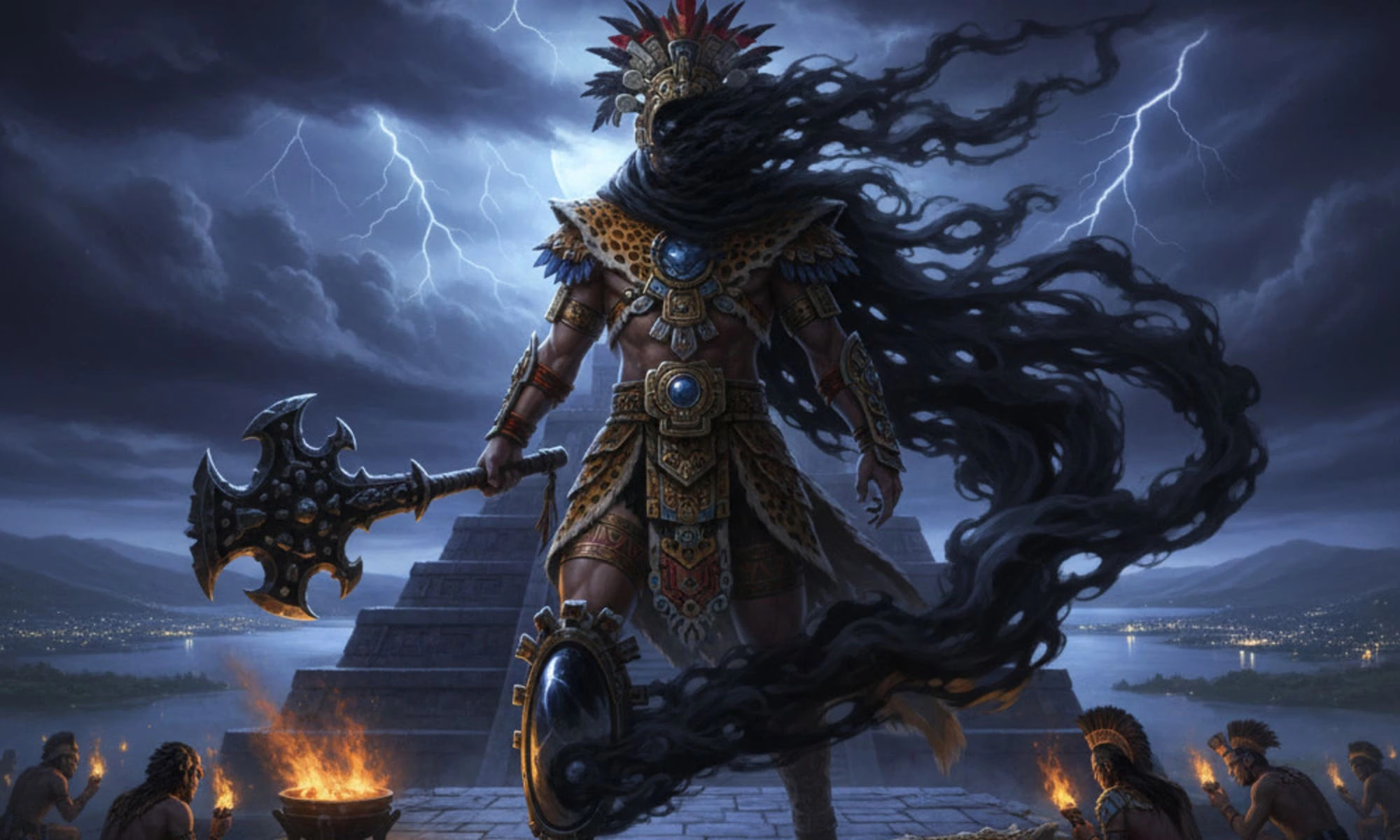
The God Who Watched from the Darkness
Long before the rise of mighty cities like Tenochtitlan, before warriors marched beneath banners of eagle and jaguar, the Aztecs believed that unseen powers governed the fate of the world. Among these powers stood a god unlike any other—a deity neither wholly benevolent nor purely destructive, a force of creation and ruin woven into the very fabric of existence. His name was Tezcatlipoca, the Smoking Mirror.
To the Aztecs, Tezcatlipoca was everywhere. He was the darkness between the stars, the whisper of destiny carried by the wind, and the hidden truth lurking beneath every illusion. While other gods ruled the sun, rain, or harvest, Tezcatlipoca ruled something far more mysterious: fate itself.
His symbol was a polished obsidian mirror, black as the night sky and capable of revealing secrets hidden from mortal eyes. Through this mirror, he watched kings and commoners alike, seeing not their faces but the desires, fears, and ambitions concealed within their hearts. No lie could escape him. No secret remained hidden for long.
Feared and revered in equal measure, Tezcatlipoca became one of the most powerful and complex deities in Aztec mythology—a god whose influence touched every corner of the cosmos.
The Creator Who Walked Beside Chaos
In many mythologies, creation begins with harmony. In Aztec belief, creation emerged from conflict.
Before the earth existed, there was only a vast primordial sea inhabited by a monstrous being known as Cipactli. This terrifying creature was part crocodile, part fish, and part toad, with mouths covering its body and an endless hunger that threatened all existence.
The gods knew that a world could not be created while Cipactli ruled the waters. It was Tezcatlipoca and Quetzalcoatl, the Feathered Serpent, who undertook the task of shaping creation.
The two divine rivals joined forces and descended into the cosmic waters. To lure the monster, Tezcatlipoca offered his own foot as bait. Cipactli seized it instantly, tearing it away. But the sacrifice was not in vain. Together, the gods defeated the beast and used its body to form the world itself.
Its flesh became the earth. Its mountains became peaks and valleys. Its hair became forests. Its eyes became springs and rivers. From the remains of chaos emerged the world of humanity.
The loss of Tezcatlipoca's foot became one of his defining symbols. In countless depictions, his missing leg is replaced by a serpent, a smoking mirror, or a jaguar limb, reminding all who see him that creation often demands sacrifice.
The Rivalry That Shaped the Cosmos
No relationship in Aztec mythology is more important than the rivalry between Tezcatlipoca and Quetzalcoatl.
The two gods represented opposing but necessary forces. Quetzalcoatl embodied wisdom, civilization, learning, and order. Tezcatlipoca represented change, challenge, fate, and the unpredictable forces of life.
Together they created the world, yet they rarely agreed on how it should be governed.
Their rivalry became the engine that drove the universe itself.
According to Aztec cosmology, the world passed through successive ages known as Suns. Each age was ruled by a different deity and eventually destroyed before a new era could begin.
Tezcatlipoca ruled the First Sun. During this age, giants wandered the earth, living beneath his dominion. But harmony did not last. Quetzalcoatl struck Tezcatlipoca from the sky, ending his reign.
Furious, Tezcatlipoca transformed himself into a mighty jaguar and unleashed savage beasts upon the world. The giants were devoured, and the First Sun came to an end.
Yet destruction was never final. Another Sun rose, another age began, and the cosmic cycle continued.
To the Aztecs, these stories explained an important truth: creation and destruction were not enemies. They were partners in an eternal cycle of renewal.
The Mirror That Revealed Truth
The name Tezcatlipoca means "Smoking Mirror," and no symbol is more closely associated with him than the obsidian mirror.
Obsidian was highly valued throughout Mesoamerica. Formed from volcanic glass, it possessed a dark reflective surface unlike any other stone. Priests polished obsidian into mirrors used for divination, prophecy, and sacred rituals.
But Tezcatlipoca's mirror was no ordinary object.
Legends claimed that it could reveal the deepest truths hidden within a person's soul. Looking into the mirror meant confronting one's true self—not the image presented to the world, but the reality beneath the surface.
Kings consulted priests who gazed into obsidian mirrors seeking divine guidance. Warriors prayed for visions before battle. Rulers feared what the mirror might reveal about their destiny.
The mirror symbolized one of Tezcatlipoca's central teachings: every person carries both light and shadow within themselves.
Truth was rarely comfortable. Yet without confronting it, wisdom could never be attained.
The Fall of Quetzalcoatl
Among the most famous stories involving Tezcatlipoca is his role in the downfall of Quetzalcoatl.
The tale unfolds in the legendary city of Tula, where Quetzalcoatl ruled as a wise and virtuous king. Under his guidance, the city prospered. Arts flourished, knowledge expanded, and the people lived in relative peace. Yet Tezcatlipoca believed that even the greatest rulers should not forget their mortality. Disguised as an old traveler, he approached Quetzalcoatl carrying a gift: pulque, a sacred alcoholic drink.
At first, Quetzalcoatl refused. But Tezcatlipoca persisted. Eventually, the ruler drank. As the intoxicating drink clouded his judgment, Quetzalcoatl lost the clarity and discipline for which he was known. Overcome by shame and regret, he abandoned Tula and journeyed eastward.
Some versions say he sailed away upon a raft of serpents. Others claim he transformed into the Morning Star. Whatever the ending, the lesson remained the same. Even gods and kings are vulnerable to temptation. No amount of wisdom grants immunity from human weakness. And fate often arrives in unexpected disguises.
Lord of Warriors and Kings
Tezcatlipoca was not merely a cosmic force. He was also the patron deity of rulers, warriors, and nobility.
Aztec kings believed their authority flowed from divine approval. Before ascending to the throne, rulers sought Tezcatlipoca's blessing, recognizing that power was both a privilege and a burden.
Warriors likewise honored him before battle.
They admired his courage, cunning, and ability to reshape destiny. To them, Tezcatlipoca represented the unpredictable nature of warfare itself. Victory and defeat could change in an instant, just as smoke shifts direction in the wind.
His worship emphasized humility.
A king might command vast armies today and lose everything tomorrow.
A warrior might rise to glory or perish before sunset.
Only Tezcatlipoca knew how destiny would unfold.
The Festival of Toxcatl
Among the most important celebrations dedicated to Tezcatlipoca was the festival of Toxcatl.
Each year, a young man of exceptional beauty and character was chosen to represent the god on earth. For an entire year he lived in luxury, dressed in fine clothing, taught sacred rituals, and treated with immense honor.
Wherever he walked, people bowed before him.
Musicians played for him.
Nobles respected him.
Commoners admired him.
For one year he embodied Tezcatlipoca himself.
Then, on the day of the festival, he climbed the steps of a great pyramid. As he ascended, he broke the flutes he had carried throughout the year, symbolizing the fleeting nature of life and earthly pleasure.
At the summit, he was sacrificed to the gods.
To modern readers, the ritual may seem shocking. Yet to the Aztecs, it represented one of their deepest beliefs: life and death are inseparable. Every ending nourishes a new beginning.
Through sacrifice came renewal.
Through death came continuation.
Through loss came creation.
The Jaguar of the Night
Tezcatlipoca's sacred animal was the jaguar, one of the most feared predators in the Americas.
The jaguar moved silently through darkness, unseen until it chose to reveal itself. Strong, cunning, and mysterious, it perfectly embodied the god's nature.
Many depictions show Tezcatlipoca wearing jaguar skins or transforming into the beast itself.
Elite Aztec warriors known as Jaguar Warriors took inspiration from this connection. They viewed the animal as a symbol of strength, courage, and mastery over fear.
Just as the jaguar ruled the night forests, Tezcatlipoca ruled the unseen forces shaping human destiny.
The Eternal Lord of Change
What makes Tezcatlipoca remarkable is his complexity.
He was not a god of pure evil. Nor was he a benevolent protector.
He was challenge.
He was transformation.
He was the force that shattered complacency and demanded growth.
The Aztecs understood that life is rarely comfortable. Empires rise and fall. Seasons change. Fortunes shift. Even the most powerful rulers eventually disappear into history.
Tezcatlipoca embodied this reality.
His stories remind us that certainty is an illusion and that change is one of the few constants in existence.
Legacy of the Smoking Mirror
Centuries after the fall of the Aztec Empire, the image of Tezcatlipoca continues to captivate historians, storytellers, and mythology enthusiasts.
He remains one of the most fascinating figures in world mythology—a god who embodies contradiction without apology. Creator and destroyer. Trickster and kingmaker. Shadow and revelation.
The Smoking Mirror still speaks through his myths.
It reminds us that truth is often uncomfortable, that destiny is rarely predictable, and that every person carries both darkness and light within themselves.
To the Aztecs, Tezcatlipoca was not simply a deity. He was the living heartbeat of change itself, the mysterious force that ensured the world would never stand still.
And perhaps that is why his legend endures. Like smoke rising from obsidian glass, his stories continue to drift across time, inviting us to look deeper—not only into mythology, but into ourselves.
Frequently asked questions
Who is Tezcatlipoca in Aztec mythology?
Why is Tezcatlipoca called the Smoking Mirror?
What was Tezcatlipoca’s relationship with Quetzalcoatl?
What did the Toxcatl festival represent?
What does Tezcatlipoca teach us about Aztec beliefs?
Savitri and Satyavan: Love That Defeated Death
The epic love story of Savitri and Satyavan from the Mahabharata — a tale of devotion so strong that it defeated Yama, t...
Heimdall: Guardian of the Bifrost – Sentinel of the Gods
Discover Heimdall, the watchful guardian of the Bifrost bridge in Norse mythology. Learn about his role, powers, and des...