
Underworlds Compared: Hades, Patala, and Naraka

Across cultures, the underworld reflects deep fears and imagination. To ancient Greeks, Hades was a silent world where souls journeyed to face eternal fate. In contrast, Indian mythology depicts Patala as a vibrant yet ominous subterranean realm, home to Nagas and demons, embodying beauty and terror equally. Hindu and Buddhist traditions view Naraka more complexly—a fiery hell meting out moral consequences based on karma. These mythologies reveal varied perspectives on life’s mysteries beyond death, offering profound insights into our collective psyche.
⚰️ Hades: The Greek Underworld
In ancient Greek mythology, the soul's journey after death involved crossing the River Styx with Charon. Hades was both a place of judgment and rest. Upon arrival, souls faced judges—Minos, Rhadamanthus, and Aeacus—who decided their fate based on earthly deeds. Heroes and virtuous individuals went to Elysium, while those who committed heinous crimes were sent to Tartarus. This structured underworld reflected society's emphasis on honor and morality. Hades was also the god of the underworld, ruling alongside Persephone. They symbolized death, life cycles, and rebirth through seasons, embodying a complex interplay between darkness and light in ancient Greek cosmology.
The Journey of the Dead
In ancient Greek mythology, newly departed souls faced a perilous journey across one of two rivers: Styx or Acheron. The ferryman Charon controlled passage to the underworld; only those buried with an obol—a small coin—could secure his services. Without this payment, souls were doomed to wander aimlessly along the riverbanks for eternity.
Crossing into Hades and Persephone’s realm revealed a world far removed from mortal life, neither heaven nor hell but a place of shadows where many dead lived in relative peace. This nuanced perspective shows that Greek mythology offered a complex view of the afterlife, intertwining justice with mercy. For instance, in the myth of Orpheus and Eurydice, when Orpheus descended to reclaim his wife, he encountered rules governing the underworld. Here, each soul's fate was determined by both its actions and the rituals performed on Earth.
The Realms Within Hades
In Greek mythology, Hades is often misunderstood as a monolithic realm of perpetual darkness. However, it houses distinct areas that mirror the complexities of human existence. The Asphodel Meadows, for instance, are where ordinary souls wander in a state of forgetfulness and pallor.
Elysium stands in stark contrast as the favored abode of heroes and the virtuous. This domain is a haven of perpetual joy and springtime beauty, symbolizing ultimate divine favor. Yet, one might wonder how such varied fates could coexist within the same underworld.
Tartarus, on the other hand, represents an abyssal realm of torment reserved for the most heinous wrongdoers. Unlike the grey neutrality of Asphodel, Tartarus is a place where punishment fits the crime, embodying divine justice in its harshest form. For example, King Sisyphus was condemned to roll a boulder uphill forever, symbolizing his eternal struggle with deceit.
Tone of Hades
In ancient Greece, the realm of Hades was neither a place of fiery torment nor one of divine punishment. Instead, it was envisioned as a shadowy kingdom of inevitability—cold, impartial, and eternal. This portrayal reflected a deep-seated belief in the finality and universality of death. Greek mythology emphasized that regardless of social status or personal achievements, every soul would eventually face this unyielding truth.
One vivid example is the story of Alcestis, who willingly sacrificed her life to save her husband's. Despite her noble act and divine intervention by Hercules, she still had to submit to Hades' realm. This narrative underscores how even heroic figures are subject to death’s impartiality. The concept of an eternal afterlife devoid of reward or punishment for earthly deeds was a stark reminder that human accomplishments ultimately hold no sway in the face of mortality.
🐍 Patala: The Shining Depths of Indian Lore
Patala, the vibrant underworld of Hindu mythology, stands in stark contrast to its Western counterpart. Unlike Hades' desolate and dreary landscape, Patala is a realm of paradoxes, brimming with life and prosperity beneath the earth's surface. According to the ancient Puranas, this subterranean world extends seven layers deep, each more opulent than the last.
Imagine a city where light emanates from gemstone-laden palaces and streets paved in gold, Patala is far removed from typical depictions of hell. One such palace, made entirely of precious jewels according to folklore, would dazzle visitors with its radiant glow, illuminating the entire underworld during the darkest nights.
While Patala appears as a beacon of light and luxury on one hand, it also houses formidable beings like Nagas — snake deities who guard treasures hidden in these depths. This juxtaposition highlights how Indian lore integrates beauty and danger, reflecting complex cultural narratives about life’s dualities.
Inhabitants of Patala
The underworld realm of Patala is home to various mythical beings, each with unique stories and roles. The Nagas, serpent beings renowned for their wisdom and power, are among the most intriguing inhabitants. Known for guarding treasures deep within the earth, these serpents often serve as protectors and guides.
Opposing the divine forces above ground are the Daityas and Danavas, mighty demons who continuously challenge the gods of the upper worlds. These fierce beings embody chaos and resistance, making Patala a battleground for cosmic conflicts that shape the destinies of both realms.
Bali's Just Rule
A notable figure within Patala is Bali, the Asura king, who was banished here after being defeated by Vishnu in his Vamana avatar. Despite this humiliation, Bali ruled with remarkable fairness and virtue, earning respect among both his subjects and those above ground.
Tone of Patala
Patala was a realm not defined by torment but rather by hidden beauty and mystery. It symbolized the depths of desire, temptation, and power — elements that were both radiant and dangerous at the same time. This place was unique because light and darkness coexisted there, creating an intricate tapestry of allure and caution.
Imagine standing in a dimly lit chamber where every flicker of light revealed more shadows; such was Patala's paradoxical nature. It wasn't just a place of fear but also one of intense beauty, much like the mesmerizing allure of a venomous flower that both attracts and repels with its vibrant colors. In this realm, one could find stunning vistas alongside treacherous pathways, embodying the idea that beneath every surface lies a depth worthy of exploration.
Light and darkness coexisted in Patala, making it a place where beauty was never far from danger.
🔥 Naraka: The Realm of Punishment
In Hindu and Buddhist traditions, the realm of Naraka is a place of fiery retribution, starkly contrasting the serpentine beauty of Patala. Here, souls endure intense suffering as a direct consequence of their earthly misdeeds, making it a hell of consequences where moral justice reigns.
Naraka’s role in religious doctrine goes beyond mere punishment; it serves as a critical stage for spiritual cleansing and redemption before the cycle of rebirth begins anew. For instance, a person who committed grave sins like murder or betrayal might find themselves trapped in Naraka for centuries, facing torments that match their transgressions.
Interestingly, while most religious texts describe Naraka as an eternal torment, some schools of thought propose that the duration spent there is proportional to one’s misdeeds—a nuanced perspective that aligns with the concept of karma, suggesting a balance rather than infinite punishment.
Yama’s Judgment
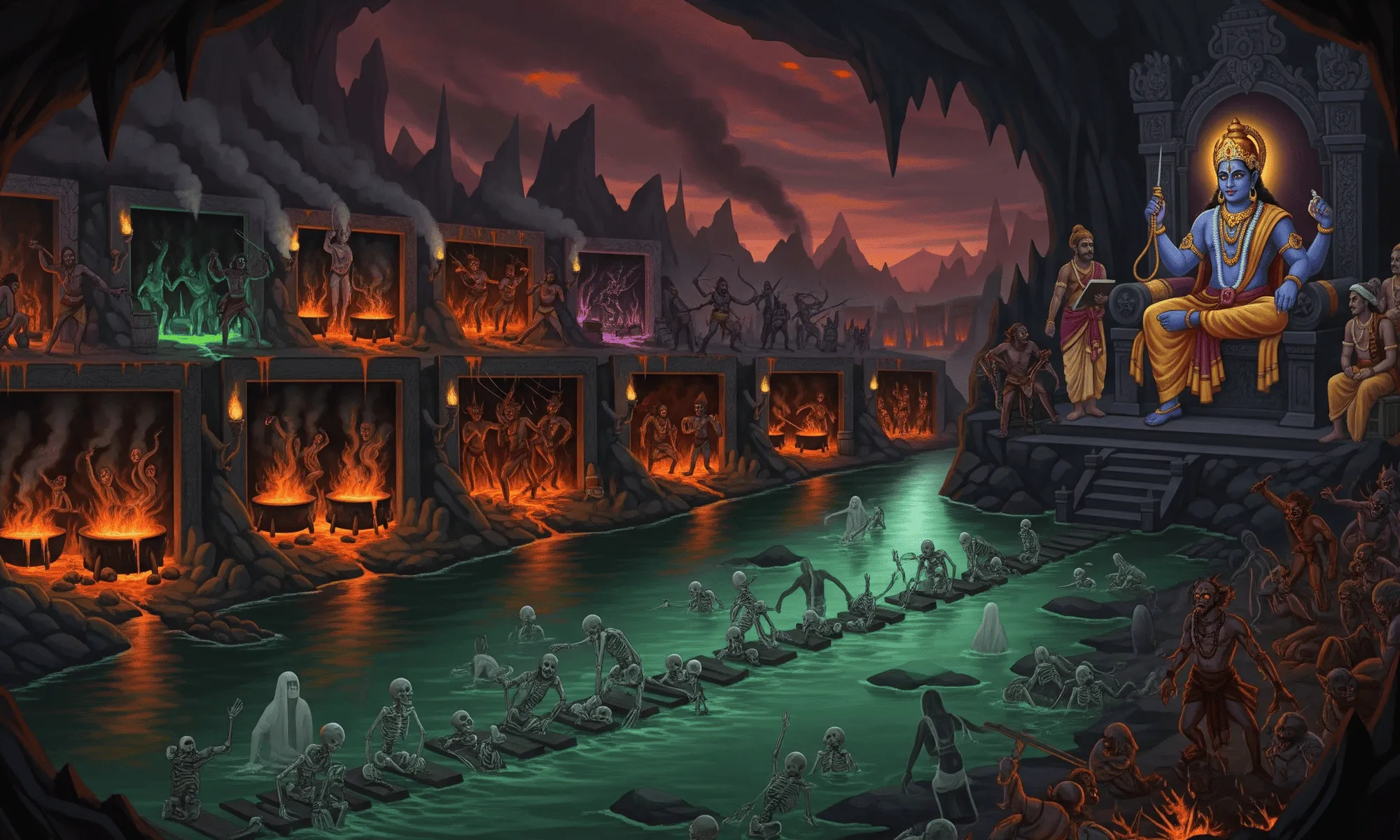
In ancient Hindu and Buddhist traditions, Yama, the god of death, judged souls after death through karma. Souls marred by evil deeds faced Naraka, a realm of punishment and suffering. Righteous souls received Swarga, a celestial paradise. This judgment was not just about retribution but spiritual growth and purification. For example, a benevolent king who governed wisely and justly was granted eternal bliss in Swarga.
Yama's role also included judging souls that were neither entirely good nor bad, leading to rebirth based on karma. Often misunderstood as simple reincarnation, this process includes moral accountability and redemption potential. This nuanced view highlights the complexity of Yama's judgment.
The Torments of Naraka
In ancient texts, Narakas—purgatorial realms—are depicted as punishments tailored to specific sins. Raurava, for instance, is an inferno where liars suffer unimaginable agony from serpents of flame. Kumbhipaka is notorious for boiling the souls of greedy and self-indulgent beings in cauldrons, cleansing them of material desires. Violent individuals face karmic consequences in Andhakupa, relentlessly attacked by ferocious beasts, symbolizing life’s turmoil and aggression. Despite harrowing conditions, Naraka is not eternal but a temporary state for purification before rebirth and redemption.
Tone of Naraka
In Naraka, the tone is one of profound cosmic justice rather than unending despair. Suffering teaches lessons about action consequences that mere words cannot convey. Each soul's journey reflects past misdeeds' depth and gravity. For instance, Aria, a corrupt official on Earth, navigates Naraka’s treacherous landscapes linked to her failures. Her trials ensure she understands her wrongdoings clearly. Interestingly, while expected darkness prevails, hope is subtly woven into this justice fabric. Each soul has the chance to learn and evolve, adding redemption to their journey. This perspective challenges the simplistic view of Naraka as only a place of punishment.
🌍 Comparing the Underworlds
The underworlds in Greek, Indian, and Hindu/Buddhist traditions serve as vivid reflections of their respective cultural philosophies. Hades in Greek mythology is a neutral realm where all souls eventually find rest or punishment, embodying an inevitable destiny beyond human control. In stark contrast, Patala from the Indian tradition stands out for its luxurious yet dangerous ambience, offering both pleasure and peril to its denizens.
For instance, Hades is ruled jointly by Hades himself and his queen Persephone, reflecting a balance between malevolent power and feminine influence. Meanwhile, Patala's governance involves the Asuras, serpents, and Nagas under the leadership of Bali and other entities, painting a picture of diverse and chaotic rule. Naraka, however, takes on a more structured punitive role, overseen by Yama, the god of death. This realm acts as a temporary purgatory for souls awaiting rebirth, emphasizing the cyclical nature of life and karma.
| Aspect | Hades (Greek) | Patala (Indian) | Naraka (Hindu/Buddhist) |
|---|---|---|---|
| Nature | Realm of the dead | Subterranean paradise of demons & Nagas | Hell of punishment & karma |
| Tone | Neutral, shadowy, inevitable | Luxurious yet dangerous | Firy, corrective, moral |
| Purpose | Destination for all souls | Dwelling of Asuras & serpents | Temporary punishment before rebirth |
| Ruler | Hades & Persephone | Bali, Nagas, Daityas | Yama, god of death |
Interestingly, while Hades' neutral tone might seem less dramatic, it actually underscores the profound impact of fate on human life—a perspective often overlooked in more colorful depictions of otherworldly realms.
✨ Symbolism
The figure of Hades serves as a poignant reminder that death is an inescapable part of life, stripping away the illusions of status and power. This mythological character underscores the universality of our shared fate, challenging us to consider what truly matters beyond earthly achievements.
Patala, on the other hand, reveals a darker aspect by highlighting how the allure of hidden power can mask profound dangers lurking beneath the surface. It cautions against being seduced by superficial beauty and warns that the true nature of such attractions often harbors significant risks.
In contrast, Naraka offers a specific insight into the concept of karma through its depiction as a place where actions in life have direct consequences in the afterlife. This belief system encourages individuals to reflect on their behavior and consider how it will affect not just their present but also their future existence. For instance, the Bhagavad Gita, an ancient Indian scripture, elaborates on this idea by discussing the importance of righteous action to ensure a better rebirth.
🌑 Conclusion
The ancient Greeks saw the underworld as a shadowed reflection of earthly life, where acts and thoughts had consequences. Indians viewed it as both a treasure trove for wisdom seekers and a trial for those who strayed from righteousness, revealing death is not just punishment but an opportunity for profound learning.
Hindus and Buddhists developed this idea by seeing the underworld as a realm where karma is refined, shaping the soul before reincarnation. Each culture’s mythological underworld serves as a unique educational space, teaching lessons about morality and existence. For example, Yama, Hindu lord of death, judges souls based on their actions in life, offering a reminder of ethical living.
Across these beliefs, death is a transformative journey leading to greater understanding and renewal.
Frequently asked questions
What is Hades in Greek mythology?
What is Patala in Indian mythology?
What is Naraka in Hinduism and Buddhism?
How do Hades, Patala, and Naraka differ?

Freyja: Goddess of Love, War, and Magic
Discover Freyja, the Norse goddess of love, beauty, war, and seidr magic. Explore her myths — from her necklace Brísinga...

The Trickster Raven: Beyond the Light – Further adventures and lessons of cunning
Explore the legend of the Trickster Raven, a cunning and transformative figure in Native American mythology. Discover ta...


