Kalki: The Final Avatar of Vishnu – The Warrior of the Future
Discover the ten avatars of Lord Vishnu and their stories.
- 1Matsya Avatar – Epic Story of Vishnu’s First Incarnation
- 2Kurma Avatar: Vishnu as the Cosmic Tortoise
- 3Varaha Avatar: The Cosmic Boar Who Lifted the Earth from the Depths
- 4The Story of Narasimha: Half-Man, Half-Lion Avatar
- 5Vamana Avatar: The Dwarf Who Measured the Universe
- 6Parashurama Avatar: The Warrior Sage Who Wielded the Axe of Justice
- 7Rama Avatar: The Ideal King and Hero of the Ramayana
- 8Krishna: The Divine Flute Player and Eternal Guide
- 9Buddha: The Enlightened One – Ninth Avatar of Vishnu
- 10Kalki: The Final Avatar of Vishnu – The Warrior of the Future (you are here)
The final avatar of Vishnu, Kalki, stands apart from the others due to his status as an unfulfilled prophecy. While Rama and Krishna have been revered for their historical roles in preserving dharma, Kalki remains shrouded in mystery, awaiting a time when righteousness will be scarce.
Kalki's arrival is tied to the concept of the end of Kali Yuga, a period marked by moral decline and chaos. This avatar signifies both the destruction of an era dominated by darkness and the rebirth of a world where dharma reigns once more, promising redemption amid despair.
In Hindu scriptures, it is said that when the world is on the brink of annihilation due to widespread corruption, Kalki will descend with his divine horse, striking fear into the hearts of evildoers while bringing solace to the virtuous. For instance, the Bhagavata Purana predicts a future where societal norms are distorted and justice is nearly nonexistent, setting the stage for Kalki's intervention.
🌑 The Darkness of Kali Yuga
In Hindu mythology, the period known as Kali Yuga is depicted as an age marred by moral decay and societal dysfunction. According to ancient texts, truth becomes obscured by deceit, and integrity gives way to rampant greed. Families disintegrate under the strain of these harsh conditions, with values like honesty and compassion being cast aside in favor of personal gain.
Moreover, leadership within this era is often marked by corruption, as leaders prioritize their own interests over those of the people they serve. This creates a pervasive sense of disillusionment among citizens who feel powerless against the rising tide of selfishness and chaos. As these elements spread unchecked across society, they fuel further division and conflict, much like how fire consumes everything in its path.
Amidst this bleak landscape, there is still hope offered by tradition: Vishnu, often depicted as a protector and preserver, will eventually return as Kalki to restore balance. This promise serves as a beacon of light for those struggling through the darkness of Kali Yuga. For instance, during the partition of India in 1947, when violence and chaos were rampant, many people clung to such spiritual promises for solace and guidance.
⚔️ The Coming of Kalki
The Puranas detail the birth of Kalki in Shambhala, a village where Vishnuyasha and Sumati will raise their son as he prepares to herald significant changes. His arrival is marked by cosmic disturbances: thundering skies and flickering Dharma, signaling an era of instability. Even celestial beings look forward to his descent.
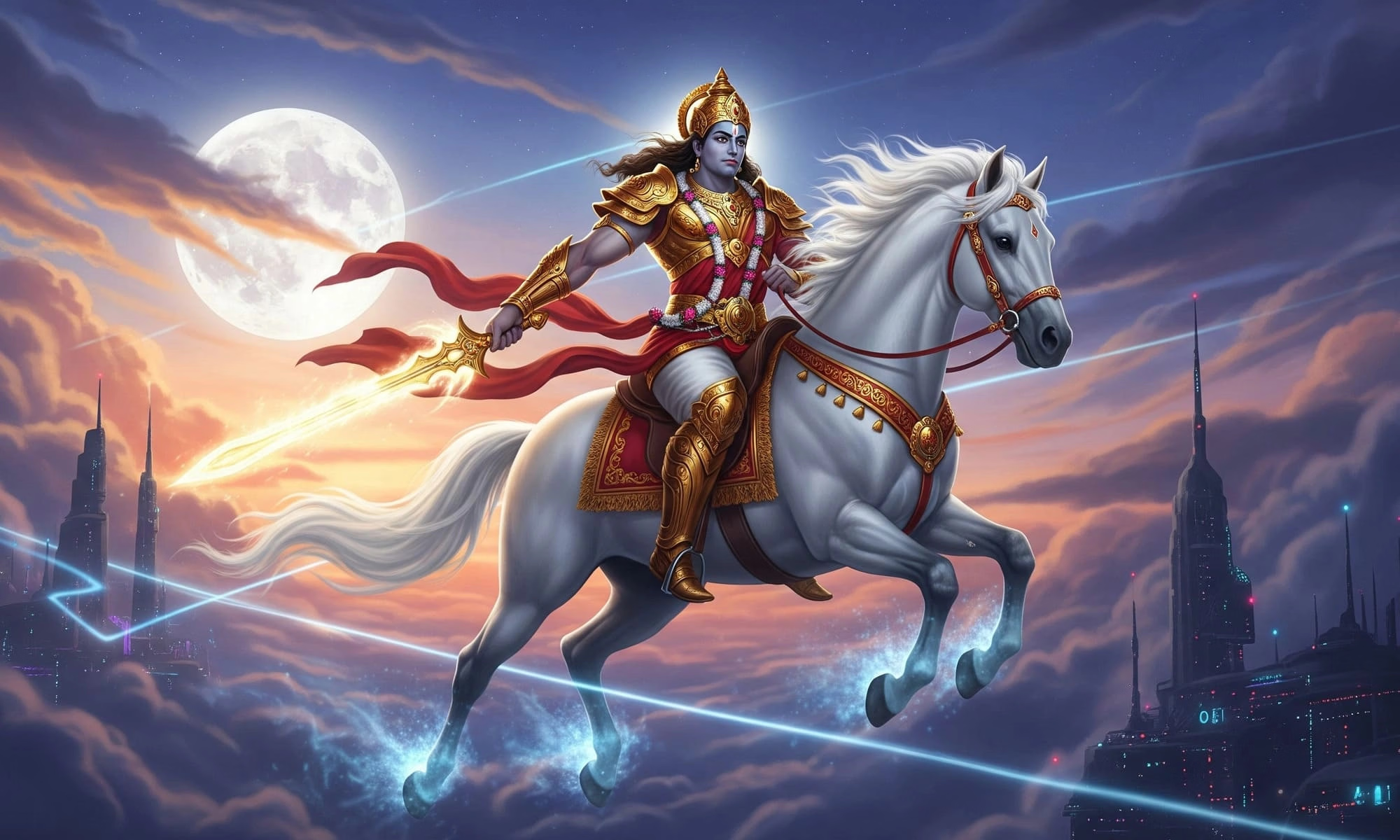
Mounted on Devadatta, a white steed symbolizing purity and speed, Kalki carries a blazing sword that embodies the fierce determination required for his mission. Unlike previous avatars who taught compassion and righteousness, Kalki’s role is decidedly destructive—he aims to eradicate unrighteousness and reset the cosmic order. Interestingly, this violent cleansing phase may actually represent a period of profound transformation rather than mere chaos.
Historically, such apocalyptic figures in mythology often serve as metaphors for societal upheaval and renewal. For instance, the Puranic tales suggest that Kalki’s advent corresponds with major epochs where traditional values falter and new paradigms emerge. In this context, Kalki’s arrival is not just a prediction but an archetype for pivotal moments in human history when radical change becomes necessary.
🔥 The Warrior of the End
Kalki is revered as a fearless warrior in Hindu eschatology, destined to ride forth on horseback at the end of the Kali Yuga. His legendary steed, Devadatta, gallops with unmatched speed, capable of covering vast distances in mere moments. This swift and formidable mount enhances Kalki's ability to swiftly move through territories plagued by oppression and corruption.
With each stroke of his radiant sword, which outshines the sun itself, Kalki decimates false rulers who have inflicted tyranny upon their people. Each swing not only signifies the end of one despot but also marks a new era of righteousness and truth. For instance, in ancient Indian literature, it is noted that Kalki's arrival will coincide with the restoration of Dharma, or cosmic order, bringing about a period of unprecedented peace.
Interestingly, while many may view Kalki as an unyielding force for justice, his actions also highlight the importance of introspection and moral clarity. By eliminating falsehood and cruelty, he underscores that true progress can only occur when individuals and societies commit to ethical living and governance. This nuanced perspective reveals that Kalki's mission is not merely about physical conquest but a profound transformation of societal values.
🌸 The Dawn of Satya Yuga
The destruction wrought by Kalki heralds a new era in which truth and purity prevail. Rivers will flow crystal clear, forests will thrive with an abundance of life, and humanity will find its place within the natural order once more. Dharma, the divine law that guides all beings, will illuminate this epoch, restoring cosmic balance after a period of chaos.
Far from being merely a harbinger of destruction, Kalki embodies the transformative power of renewal. His arrival signifies the end of an old cycle and the beginning of Satya Yuga, where righteousness reigns supreme. For instance, in ancient Indian texts, it is prophesied that during this era, societal norms will shift towards virtuous living, reflecting a profound change from previous corrupt times.
Thus, Kalki's role extends beyond immediate destruction; he paves the way for an age where humanity reconnects with its spiritual essence. This transition, akin to a tempest preceding dawn, is crucial as it sets the stage for a world reborn in harmony and truth. Interestingly, this period of renewal is often seen not just as a return to ancient ideals but also as a catalyst for new societal advancements that enhance human potential.
🌍 Symbolism of Kalki
The symbolism surrounding Kalki's avatar is rich and profound, reflecting themes of purification and renewal. The white horse, symbolizing purity and unstoppable momentum, represents the divine intervention that sweeps through the world with unwavering determination.
A key element in this narrative is Kalki’s flaming sword, a potent emblem for truth that cuts through falsehoods and exposes corruption. This weapon not only signifies the destruction of evil but also heralds the dawn of a new era devoid of deceit. For instance, consider the historical context of religious reform movements where leaders emerge to purify teachings and practices.
Perhaps most intriguing is the prophecy associated with Kalki: rather than viewing it as an apocalyptic end, it foretells a transformation—a new beginning filled with hope and renewal. This perspective challenges conventional views on endings, suggesting that even in the darkest times, a brighter future awaits those who embrace change.
🕊️ Awaiting Kalki
The Kalki prophecy isn't just about an impending cosmic event; it resonates deeply within each individual. When faced with personal challenges, such as the rise of ignorance, greed, and anger, one must look inward to summon their own inner Kalki—a symbol of enlightenment and clarity.
As the final avatar in Hindu mythology, Kalki represents not just an external warrior but also a guiding spirit that awakens within us. This divine figure embodies the eternal struggle between darkness and light, urging individuals to confront their deepest fears and transform them into sources of strength.
"When the dark ages prevail, truth is lost amidst chaos," yet Kalki's arrival promises not just deliverance but also a profound spiritual awakening for humanity.
In practical terms, this means that every time we face moral dilemmas or societal issues, we have an opportunity to act as our own avatars of light. For instance, in the context of global environmental crises, individuals and communities can take proactive steps to restore balance and truth—mirroring Kalki's mission on a smaller scale.
Frequently asked questions
Who is Kalki in Hindu mythology?
When will Kalki appear?
What is the role of Kalki avatar?
What does Kalki's white horse symbolize?
Sekhmet: The Lioness Goddess of War and Healing
Discover the story of Sekhmet, the lioness-headed Egyptian goddess of war and healing. Learn how the daughter of Ra beca...
Divs and Demons of Persian Lore – Evil beings, magical wars, and symbolic meanings
Dive into Persian mythology with tales of Divs and demons. Explore their battles, symbolism, and the magical wars that s...