Janus: The Two-Faced God of Beginnings and Endings
Among all the gods worshipped by the Romans, none was more uniquely Roman than Janus. He had no Greek equivalent, no borrowed legends from foreign lands, and no thunderbolts or mighty armies under his command. Yet every prayer, every journey, every war, and every new year began with his blessing.
For Janus was the god of beginnings and endings, of gates and doorways, of transitions and time itself.
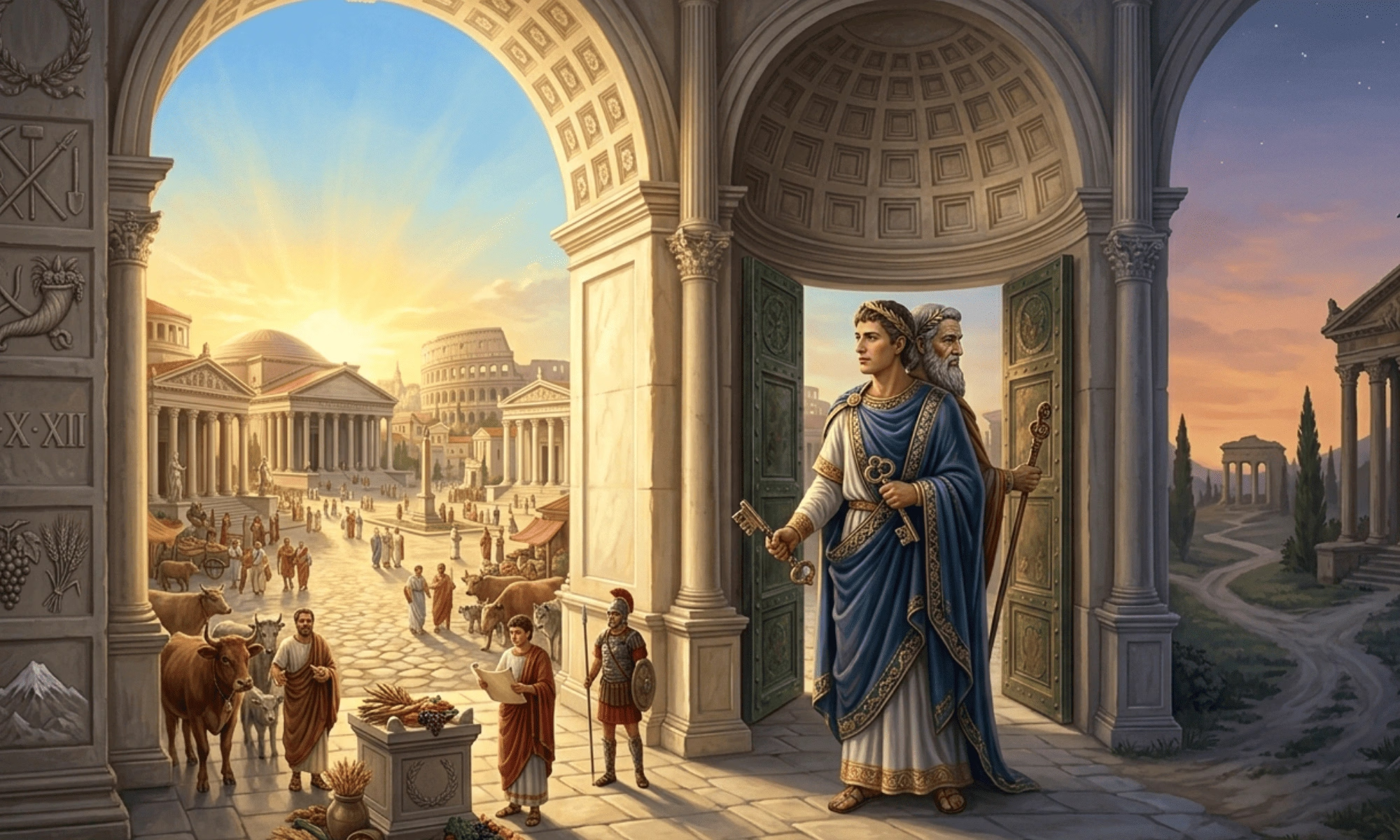
He stood where one thing became another. He watched over the moment between yesterday and tomorrow, between peace and war, between birth and death. And unlike other gods who looked only ahead, Janus possessed two faces—one gazing toward the past and the other toward the future.
To the Romans, this strange appearance was not a curse. It represented wisdom itself. For only by understanding what had been could one truly prepare for what was to come.
The God Who Came Before Jupiter
Long before Rome rose to dominate the Mediterranean, Janus already held a sacred place in ancient Italian traditions. Some legends claimed that he had once ruled Latium as a wise king during a golden age, welcoming the exiled Saturn and teaching humanity the arts of agriculture, laws, and civilization.
Other stories declared that Janus was older than Jupiter himself.
Unlike the warrior gods or the gods of the sky, Janus existed at the very beginning of things. Every creation required a first step, and every first step belonged to him.
Because of this, Romans invoked Janus before all other gods. Even Jupiter, king of heaven, received prayers only after Janus had opened the path between mortals and the divine.
No sacrifice, no festival, and no undertaking could begin without acknowledging the guardian of beginnings.
The Meaning Behind His Two Faces
Perhaps no image in Roman mythology is more recognizable than the double-faced Janus.
One face appeared old and wise, its eyes fixed upon the past. The other was youthful, looking toward the future.
Together, they represented a truth the Romans deeply respected: wisdom comes from remembering where one has been while preparing for where one must go.
Janus was not two gods joined together. He was a single being embodying duality itself.
He governed all transitions:
- Youth and old age.
- Sunrise and sunset.
- Peace and war.
- Birth and death.
- Departure and arrival.
His nature reflected the Roman understanding that life itself consisted of thresholds. Every ending contained the seed of a new beginning.
Lord of Doors, Gates, and Pathways
The name Janus comes from the Latin word ianua, meaning "door."
To modern minds, doors are simple objects. But to the Romans, a doorway represented something sacred. It marked the boundary between one world and another. Crossing a threshold meant entering a new state of existence.
Janus became the protector of every entrance and exit.
Homes, temples, cities, and even roads fell under his watchful gaze.
Travelers prayed to him before journeys. Newly married couples invoked him when entering their homes. Soldiers sought his blessing before campaigns, and farmers honored him at the beginning of each season.
Nothing important began without first passing through the invisible doorway guarded by Janus.
The Gates of Janus and the Fate of Rome
Among Rome's most sacred structures stood the Temple of Janus, whose bronze doors carried immense symbolic significance.
These gates remained open whenever Rome was at war.
They closed only during times of complete peace.
Because the Roman Republic and Empire spent much of their history engaged in conflict, the gates rarely shut. In fact, ancient historians recorded only a handful of occasions when they were closed.
One of the most famous occurred during the reign of Augustus, who proudly announced that he had brought peace to the Roman world.
For Romans, the opening and closing of Janus's gates reflected the state of civilization itself. They symbolized not merely military campaigns but the fragile balance between chaos and order.
When the gates stood open, Rome marched.
When they closed, the empire rested.
Janus and the Beginning of the Year
Even today, Janus continues to influence daily life in a remarkable way.
The month of January bears his name.
For the Romans, the first month of the year naturally belonged to the god who presided over beginnings. As one year ended and another commenced, Janus stood at the threshold, watching both behind and ahead.
The festival of Kalends celebrated the arrival of the new year. Families exchanged gifts, decorated their homes, and prayed for prosperity.
People offered honey, dates, and wine to Janus, hoping that sweetness and abundance would accompany the months ahead.
Though centuries have passed, every New Year's celebration still carries echoes of these ancient traditions.
Whenever people make resolutions and look toward the future while reflecting on the past, they unknowingly honor the wisdom of Janus.
The Keeper of Time and Change
Unlike Chronos or Saturn, Janus was not time itself.
He was the moment of transition.
He ruled over change.
The Romans understood that life never stands still. Empires rise and fall. Seasons change. Children grow old. Victories become memories.
Janus represented acceptance of this truth.
His two faces reminded people that the future cannot be entered without carrying the lessons of the past. Likewise, one cannot cling forever to what has ended.
Every door eventually closes.
Every new path eventually opens.
Janus stood in the middle, ensuring that the cycle continued.
Why Janus Had No Greek Equivalent
Most Roman gods shared origins with Greek deities.
Jupiter resembled Zeus.
Venus mirrored Aphrodite.
Mars was often compared with Ares.
But Janus stood alone.
The Greeks possessed no equivalent god.
This uniqueness made Janus one of the most distinctly Roman deities. He embodied qualities central to Roman identity—discipline, foresight, tradition, and respect for the passage of time.
He was less concerned with passion and heroism than with order and continuity.
In many ways, Janus represented Rome itself—a civilization forever looking backward to its traditions while expanding toward its future.
Legacy of the Two-Faced God
Although the old temples of Rome have long fallen silent, Janus has never truly disappeared.
His image survives in language, art, and philosophy.
The very concept of "looking both ways" before making decisions echoes his wisdom.
Historians see him as a symbol of reflection and foresight. Philosophers interpret him as the embodiment of life's transitions. Artists portray him as a guardian of memory and hope.
Even the phrase "Janus-faced" has entered modern vocabulary, though often stripped of its original meaning. To the Romans, possessing two faces was not a sign of deceit but of understanding.
For Janus saw what others could not.
He understood that beginnings and endings are never separate.
They are merely two sides of the same door.
Conclusion
Janus was unlike any other god in Roman mythology.
He wielded no thunderbolt, fought no great monsters, and commanded no armies. Yet kings and generals, merchants and farmers, priests and travelers all sought his blessing before taking their first steps.
He stood at every threshold, silently watching the endless procession of time.
One face remembered what had been.
The other anticipated what was yet to come.
And between them stood the present—the fleeting moment where all lives unfold.
Perhaps that is why the Romans honored Janus above all others at the start of every endeavor.
For before every journey, before every triumph, and before every new chapter, there is always a doorway.
And beyond that doorway waits Janus, the eternal guardian of beginnings and endings.
Frequently asked questions
Who was Janus in Roman mythology?
Why does Janus have two faces?
Why is January named after Janus?
What were the Gates of Janus?
Did Janus have a Greek equivalent?

Matsya Avatar – Epic Story of Vishnu’s First Incarnation
Discover the epic story of Matsya, Vishnu’s first avatar, who saved the world from a cosmic flood and preserved the Veda...

Domovoi: The Guardian Spirit of the Slavic Home
Discover the Domovoi, the household spirit of Slavic folklore. Learn about his role as a protector, his temper, and the ...